The Djibouti eVisa costs $23 USD for a 90-day tourist visa or $12 USD for a 14-day visa in government fees as of 2026. UK travellers pay approximately £18.67 or £10.05 total after card surcharges and bank FX markups. Applying directly on evisa.gouv.dj saves £4 to £43+ compared to third-party agencies. Last updated: 9 September 2026.
This breakdown covers every fee layer: government charge, 2.8% payment surcharge on evisa.gouv.dj, and UK bank non-sterling transaction fee of 2.75 to 3.0%. All GBP figures use the exchange rate of 1 GBP = 1.27 USD as of September 2026. The gap between the advertised $23 fee and the actual £18.67 on your statement can reach £1 to £3. This portal is informational, not a visa service provider.
What Is the Total Djibouti eVisa Cost in 2026 for UK Travellers?
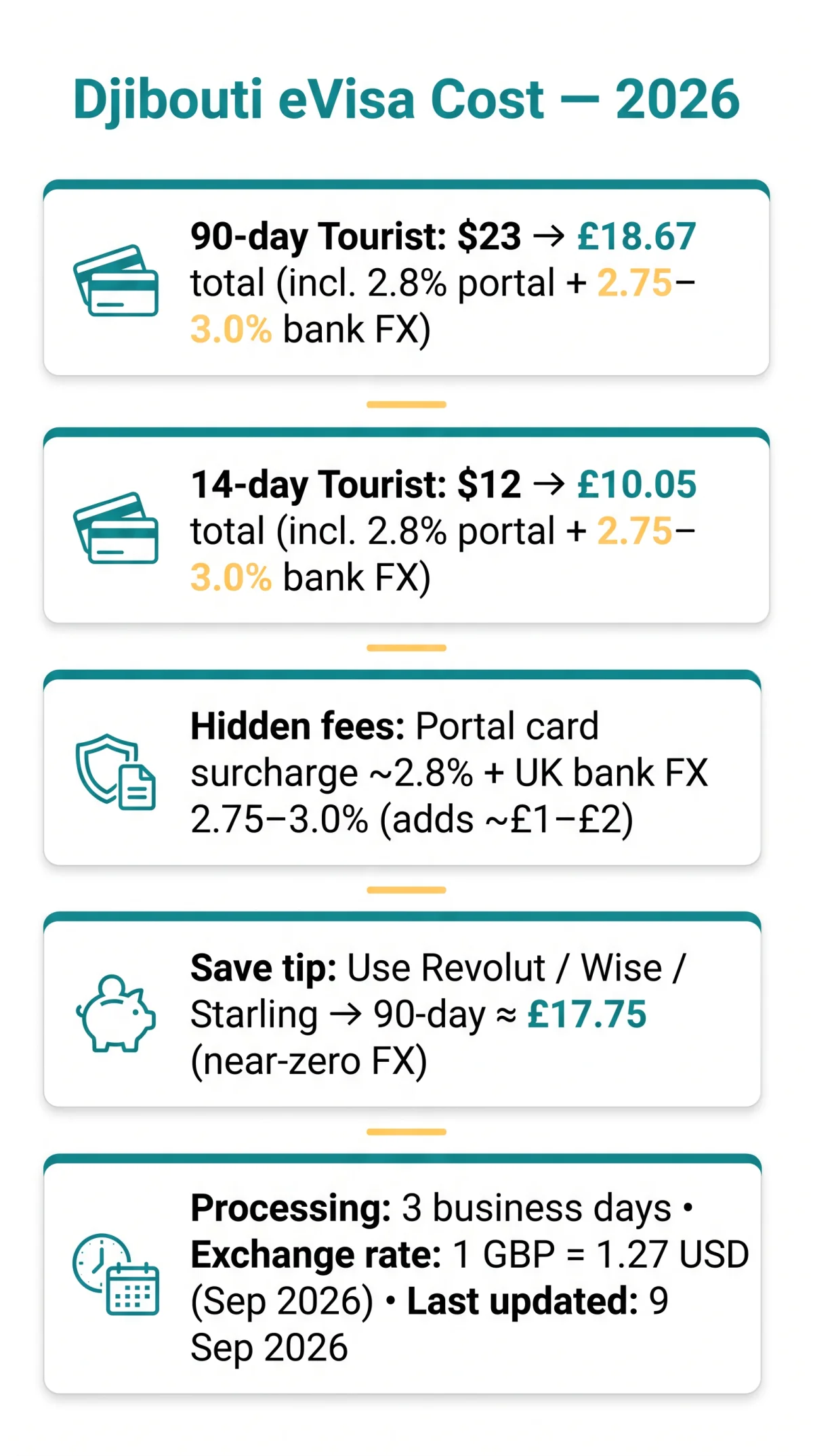
The all-in Djibouti eVisa cost for UK travellers is approximately £18.67 (90-day) or £10.05 (14-day) including government fees, card surcharges, and bank FX markups. The cost structure comprises the government visa fee in USD, a card processing surcharge on the application portal, and a currency-conversion markup applied by the cardholder’s UK bank.
| Visa Duration | Gov Fee (USD) | Card Surcharge (~2.8%) | GBP Equiv. (1 GBP = 1.27 USD, Sep 2026) | UK Bank FX Fee (~3%) | Total GBP |
|---|---|---|---|---|---|
| 14-day Tourist | $12 | ~$0.34 | ~£9.45 | ~£0.28 | ~£10.05 |
| 90-day Tourist | $23 | ~$0.64 | ~£18.11 | ~£0.54 | ~£18.67 |
UK high-street banks (HSBC, Barclays, Lloyds, NatWest) charge a non-sterling transaction fee of 2.75 to 3.0%. Travel-friendly cards from Revolut, Wise, and Starling charge ~0% FX, reducing the 90-day total to approximately £17.75. The exchange rate is variable; figures reflect the mid-market rate as of September 2026.
Djibouti eVisa Government Fee Schedule (2026)
The Djibouti government charges $23 USD for a 90-day tourist eVisa and $12 USD for 14 days, payable via Visa, Mastercard, or Amex on evisa.gouv.dj. Standard processing takes 3 business days; no expedited tier exists as of 2026.
| Visa Category | Government Fee (USD) | Max Stay |
|---|---|---|
| Tourist eVisa (14-day) | $12 | 14 days |
| Tourist eVisa (90-day) | $23 | 90 days |
| Transit eVisa | $12 to $16 (verify on portal) | Transit only |
| Business eVisa | Same as tourist ($12 / $23) | 14 or 90 days |
The eVisa system launched in May 2018, replacing visa on arrival the same month. Some third-party sites list $27 for the 90-day visa; that figure includes a merchant markup, whereas $23 is the statutory government fee.
Accepted Payment Methods on evisa.gouv.dj
The portal accepts Visa, Mastercard, American Express, and debit cards. The Djibouti eVisa cost is charged in USD, meaning UK travellers face an additional currency-conversion layer discussed in the hidden-costs section below.
Hidden Costs of a Djibouti eVisa – What You Won’t See Until Checkout
The Djibouti eVisa cost structure includes a ~2.8% card processing surcharge on evisa.gouv.dj (observed at checkout, not itemised) and a 2.75 to 3.0% non-sterling transaction fee from UK banks, adding approximately £1 to £2 on top of the advertised government fee.
Base government fee
$23 USD (90-day) or $12 USD (14-day), set by Djibouti immigration authorities.
Portal card surcharge
evisa.gouv.dj applies ~2.8% (2.5 to 3.0% range), adding ~$0.64 to a 90-day application. Not itemised at checkout; appears as a single higher charge.
Total USD charged
Approximately $23.64 for the 90-day visa.
UK bank currency conversion
The bank converts at the mid-market rate (1 GBP = 1.27 USD, September 2026) plus a 2.75 to 3.0% FX fee. HSBC, Barclays, Lloyds, and NatWest all apply this margin.
Final debit
~£18.67 on a standard UK debit card, or ~£17.75 using Revolut, Wise, or Starling, which charge near-zero FX fees.
Agency “no hidden fees” claims apply only to their service margin, not to portal surcharge or FX markup. Tip: use a zero-FX-fee travel card to avoid the bank conversion layer entirely.
Third-Party Service Fees vs Applying Direct – 2026 Cost Comparison
Third-party agencies charge £23 to £62+ total for a Djibouti eVisa versus approximately £18.67 when applying directly through evisa.gouv.dj. The cost structure is identical across channels except for the service margin.
| Channel | Total Price | Service Fee Component |
|---|---|---|
| Direct portal (evisa.gouv.dj) | ~$23.64 / ~£18.67 | None (card surcharge only ~2.8%) |
| AbroadCube (budget agency) | ₹2,499 (~$29 / ~£23) | ₹590 (~$7 / ~£5.50) |
| VisaTravel (premium agency) | €73+ VTI fee (~$79+ / ~£62+) | Consular fee display broken (“NaN€”) |
| VisaHQ | Fees not publicly listed | Undisclosed |
Agencies add document review and status tracking for their markup. This article is not affiliated. For context on which visa type suits your trip, see eVisa fees by type.
Djibouti eVisa Validity, Entry Rules & Document Requirements
The Djibouti eVisa is single-entry only, valid 31 days from your selected visit date, permitting 14 or 90 days of stay. A rejected or unused visa means paying the full $12 to $23 government fee again with no refund.
- Validity: 31 days from the selected visit date (not from approval date). Single entry only – no multiple-entry option exists.
- Maximum stay: 14 days or 90 days, depending on visa type. Stay cannot exceed the travel dates stated in the application form; the departure date must match even if entry occurs later.
- Unused visa: If you do not travel, you must reapply and pay the full Djibouti eVisa cost again. The eVisa does not guarantee entry – immigration discretion applies at the border.
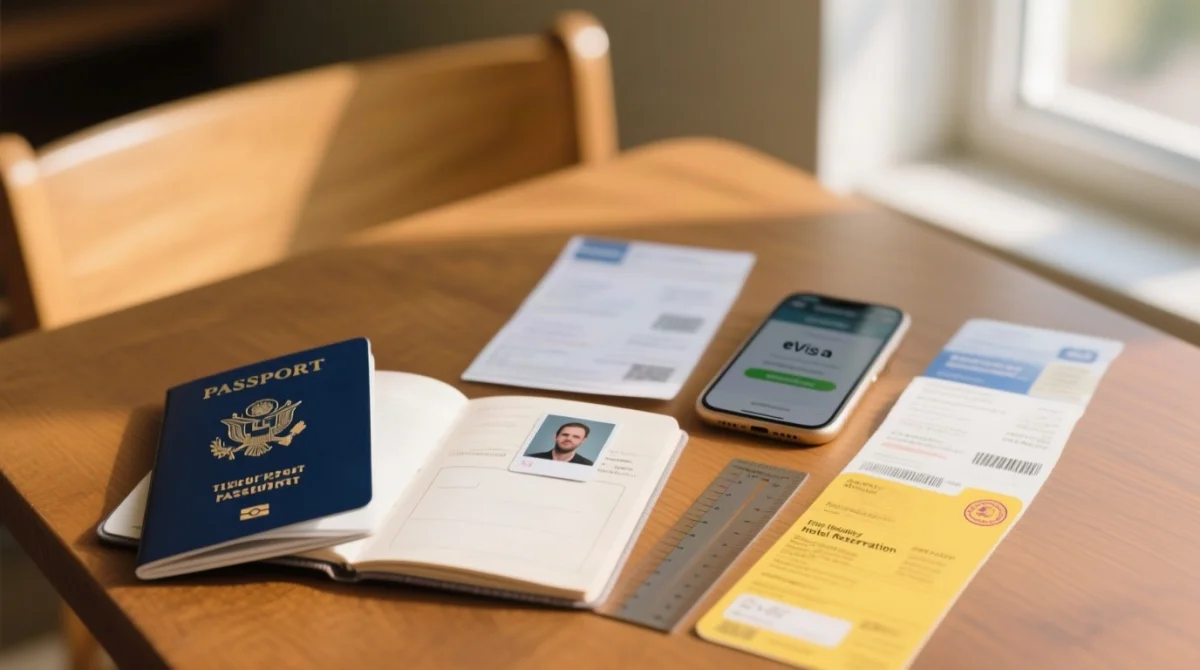
- Passport: Minimum 6 months validity from date of entry, with at least 1 blank page.
- Flight itinerary: Return or onward flight reservation under the applicant’s name is required.
- Accommodation: Hotel booking with the applicant’s name is required.
- Photo: 35 x 45 mm, white background, JPEG format, max file size 1,024 KB, face covering 70 to 80% of frame, taken within the last 6 months. A non-compliant photo can trigger rejection, forfeiting the entire fee.
- Yellow fever certificate: Conditional – required only if arriving from or transiting through WHO-designated endemic countries.
Verify all requirements before submitting on evisa.gouv.dj. See document requirements and processing time for further detail.
What Happens If Your Djibouti eVisa Is Refused or You Overstay?
Non-refundable government fees and potential overstay penalties mean a rejected application costs you the full $12 to $23 fee again. The Djibouti eVisa cost structure includes no refund mechanism: if immigration authorities reject your application, the government fee is forfeited in full. Reapplication requires paying the complete fee a second time.
Agency refund policies vary – AbroadCube maintains a general refund page but no Djibouti-specific guarantee, so verify terms before paying any service charge. Overstaying triggers daily fines. In-country extension at the Direction Generale de la Documentation et de l’Immigration (DGDI) is not guaranteed for tourists. If a transaction fails on evisa.gouv.dj, verify payment status before reapplying to avoid double charges. To minimise rejection risk, ensure photo requirements (35×45 mm, JPEG, max 1,024 KB), complete documents, and accurate travel dates. See our guide on the Djibouti eVisa arrival process.
Cost-Saving Tips & Eligibility for UK Travellers
UK passport holders are eligible for the Djibouti eVisa; applying directly with a zero-FX-fee card saves up to £43+ versus agencies. British passport holders are among 51 eligible nationalities, and Israeli passport stamps are accepted without entry denial.
- Apply directly on evisa.gouv.dj – saves £4 to £43+ compared to third-party agencies charging up to ~£62+.
- Use Revolut, Wise, or Starling for near-zero FX fees – standard UK high-street banks (HSBC, Barclays, Lloyds, NatWest) add 2.75 to 3.0% non-sterling transaction fees.
- Ensure photo and documents are compliant before submitting – a non-compliant photo (35×45 mm, JPEG, max 1,024 KB) can cause rejection and forfeit the full government fee.
- Choose the correct duration – the 14-day eVisa costs $12 USD and the 90-day costs $23 USD; don’t overbuy.
- Apply at least 2 weeks before travel – standard processing takes 3 business days and no expedited option exists as of 2026. For UK-specific practicalities
There is no British Embassy in Djibouti – UK nationals are assisted by the French Embassy in Djibouti and the British Embassy in Addis Ababa, Ethiopia. The UK FCDO travel advisory stands at Level 2 (exercise increased caution due to terrorism). This information does not constitute immigration advice; verify all fees and rules directly with evisa.gouv.dj before applying.
FAQ: Djibouti eVisa Cost Questions Answered (2026)
How much does a Djibouti eVisa cost for UK citizens in 2026?
Government fee: $23 (90-day) or $12 (14-day). With 2.8% surcharge and 2.75 to 3.0% FX, total ~£18.67 (90-day) or ~£10.05 (14-day) at 1 GBP = 1.27 USD (September 2026).
Are there hidden costs when applying for a Djibouti eVisa?
Yes. evisa.gouv.dj applies a ~2.8% card surcharge (not itemised at checkout). UK banks add a 2.75 to 3.0% non-sterling transaction fee. Together these add ~£1 to £2. Using Revolut or Wise eliminates the bank layer.
Is the Djibouti eVisa fee refundable if my application is rejected?
No. Government fees are non-refundable upon rejection. Reapplication requires paying the full fee again. Agency refund policies vary. To minimise risk: photo 35×45 mm JPEG, passport 6 months validity, complete documents.
Can I get a visa on arrival in Djibouti instead of an eVisa?
No. Visa on arrival was discontinued in May 2018, the same month the eVisa system launched. The eVisa is the only pathway for eligible nationalities, including UK passport holders. No on-arrival option exists at Ambouli International Airport or any other port of entry.
How long does Djibouti eVisa processing take, and is there an expedited option?
Standard processing takes 3 business days. No expedited or rush tier exists as of 2026. The eVisa is delivered by email. Apply at least 1 to 2 weeks before travel to allow for processing and documentation corrections.
Do children need a separate Djibouti eVisa, and is there a reduced fee?
Yes. Each traveller, including minors and infants, requires their own eVisa. No publicly documented child discount exists. The same government fees of $12 (14-day) or $23 (90-day) apply per applicant. Confirm exceptions with Djibouti immigration authorities via evisa.gouv.dj.
Which ports of entry accept the Djibouti eVisa?
The verified authorised port of entry is Ambouli International Airport (JIB) in Djibouti City. Land border acceptance is unreliable – verify with the Direction Generale de la Documentation et de l’Immigration before relying on an eVisa for overland entry. Airside transit passengers at Ambouli do not need a transit eVisa.
What payment methods have the lowest surcharges for UK travellers?
evisa.gouv.dj accepts Visa, Mastercard, and American Express. Using a zero-FX-fee travel card (Revolut, Wise, or Starling) eliminates the 2.75 to 3.0% non-sterling fee charged by HSBC, Barclays, Lloyds, and NatWest, saving ~£1 to £2 per application.
Are there British consular services available in Djibouti?
No. There is no British Embassy in Djibouti. UK nationals are assisted by the French Embassy in Djibouti and the British Embassy in Addis Ababa, Ethiopia. The UK FCDO travel advisory for Djibouti is Level 2 (exercise increased caution due to terrorism).
Can I extend my Djibouti eVisa if I overstay my permitted duration?
Overstaying carries daily monetary fines under the Djibouti immigration code. In-country extension at the Direction Generale de la Documentation et de l’Immigration (DGDI) is not guaranteed for tourists. The eVisa is single-entry with a maximum stay of 14 or 90 days. An unused visa requires a full reapplication with a new fee.