Djibouti eVisa health requirements in 2026 include a conditional yellow fever certificate, mandatory only if you arrive from or transit through an endemic country for more than 12 hours. No COVID-19 certificates or tests are required as of September 2026. Recommended vaccinations for UK visitors include typhoid, hepatitis A/B, rabies, and meningococcal (ACWY). Malaria prophylaxis is strongly advised, particularly for travel to interior regions and during the rainy season (September to December). Travel medical insurance covering evacuation and repatriation is a required document for the eVisa application checklist. Last reviewed: September 2026. Sources: gov.uk, TravelHealthPro, WHO.
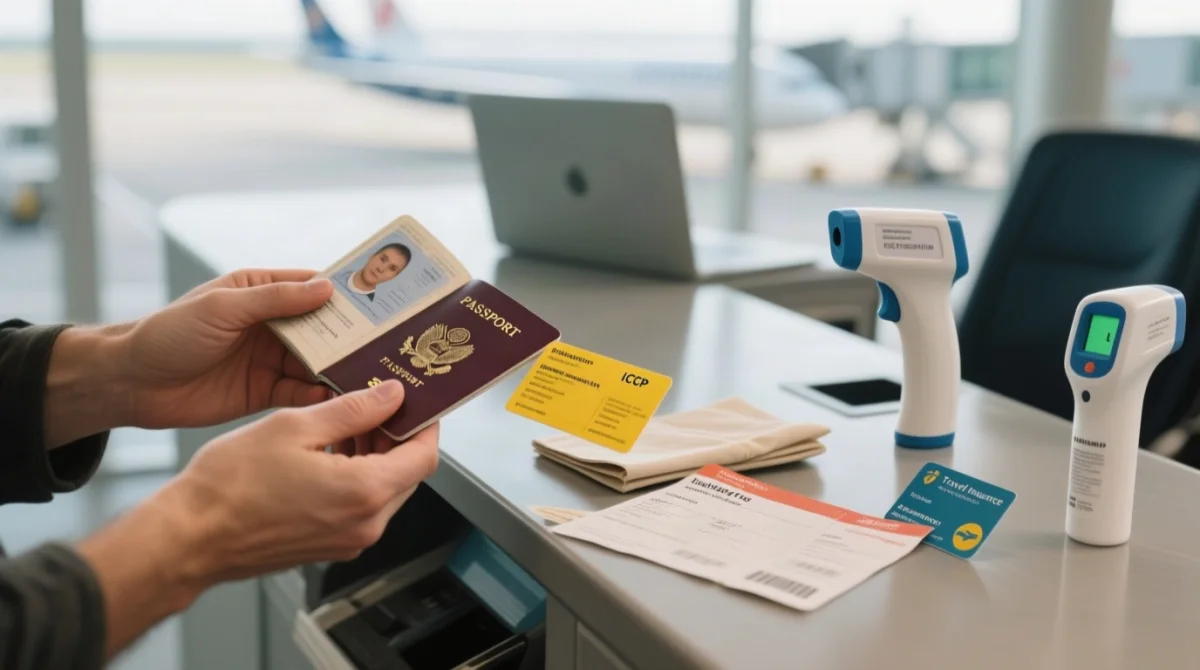
Border health checks at Ambouli International Airport may include temperature screening and visual health assessment. The eVisa processing time is 3 to 7 business days (Sunday to Thursday working week), so submit your application at least 7 days before travel. Prepare all health documents before applying online at evisa.gouv.dj.
Yellow Fever & Recommended Vaccinations for Djibouti
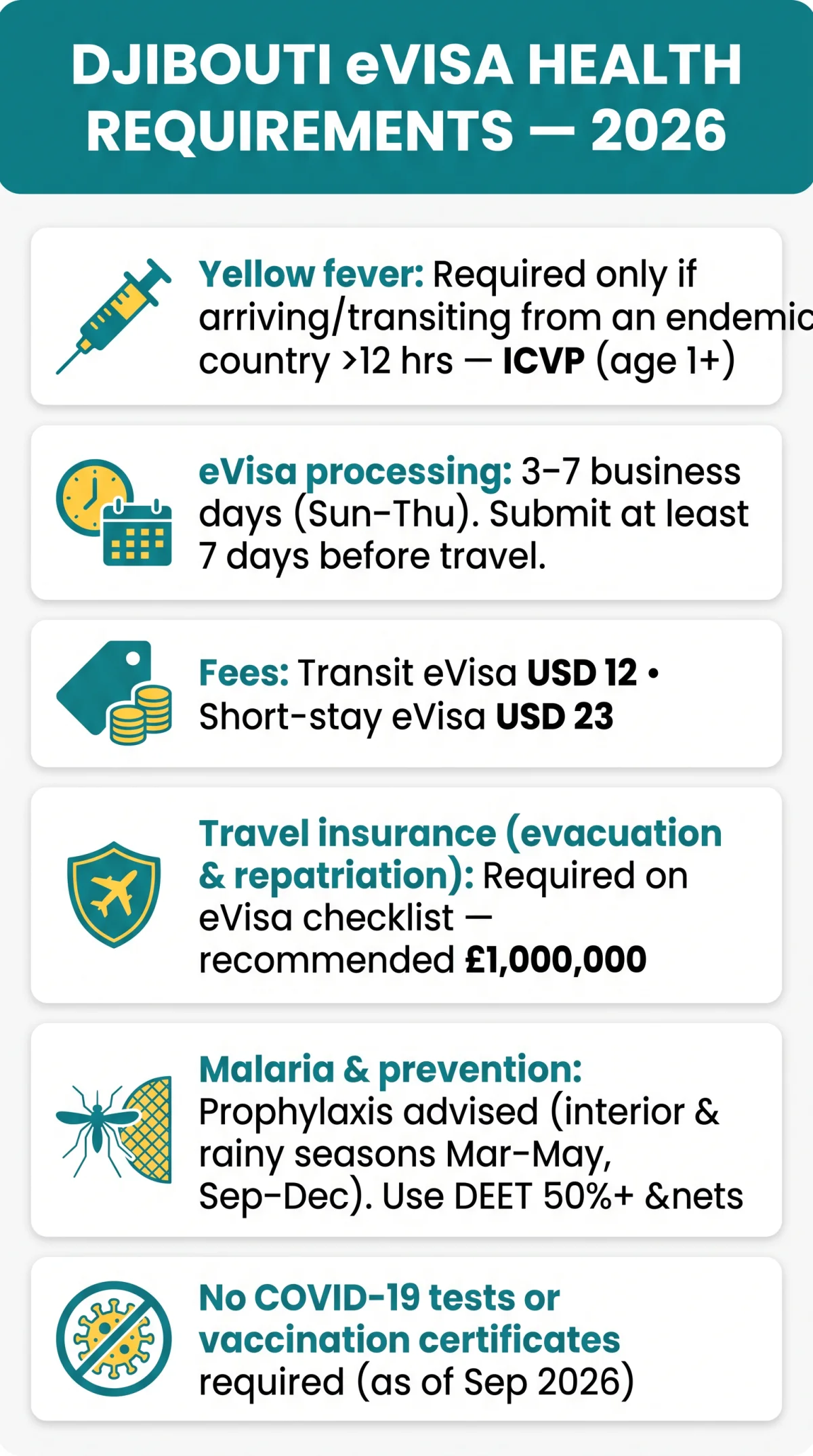
Under Djibouti eVisa health requirements, a yellow fever certificate is mandatory only if you arrive from or transit through an endemic country for more than 12 hours (per gov.uk). Direct UK-Djibouti flights do not require it. The accepted document is the International Certificate of Vaccination or Prophylaxis (ICVP), required for travellers aged 1 year or older. Since the 2016 WHO amendment, a single dose provides lifetime validity with no booster needed. UK travellers can obtain the certificate at designated Yellow Fever Vaccination Centres for approximately £50-£75; vaccination should be completed at least 8 weeks before departure. Contact Passport Health UK at 0808 164 6644 (Soho Travel Clinic). Search for designated clinics via the TravelHealthPro directory.
Djibouti eVisa health requirements also strongly recommend tick-borne encephalitis (TBE) vaccination and routine boosters for tetanus, polio, and diphtheria. Dengue, Zika virus, and schistosoma are present health risks in Djibouti with no available vaccine for dengue or Zika; prevention relies on mosquito-bite avoidance and avoiding freshwater exposure for schistosoma.
| Vaccine | Status | Notes |
|---|---|---|
| Yellow fever | Mandatory (conditional) | Only if transiting >12 hrs through endemic country |
| Typhoid | Strongly recommended | Food/waterborne protection |
| Hepatitis A/B | Strongly recommended | All UK travellers |
| Rabies | Strongly recommended | Animal exposure risk |
| Meningococcal (ACWY) | Strongly recommended | Dry season (Nov-Mar) |
| TBE | Recommended | Tick-borne encephalitis |
| Tetanus/Polio/Diphtheria | Recommended | Routine boosters up to date |
Malaria Prevention & Environmental Health Risks
Djibouti eVisa health requirements do not mandate antimalarial prophylaxis, but all UK travellers should take medication and use DEET-based repellents. Malaria transmission varies by region: Djibouti City carries low risk, while Obock district and the interior desert are higher-risk zones. Peak transmission occurs during the rainy seasons (March-May and September-December). Recommended antimalarials include atovaquone-proguanil (Malarone) or doxycycline. Use DEET 50%+ repellent and permethrin-treated mosquito nets after dusk.
Djibouti eVisa health requirements also include preparing for 40°C+ heat (peak June-August) and limited medical facilities (gov.uk). Daytime temperatures regularly exceed 40°C; drink 3-4 litres of water daily and avoid outdoor activity between 11:00 and 15:00. Consume bottled water only and carry oral rehydration salts for travellers’ diarrhea. Dust storms are frequent from April to October – wear an N95 mask. Medical facilities in Djibouti are limited; emergency ambulance numbers are 21 35 09 62 and 21 35 27 12. Blood supply infrastructure is limited with restricted infectious-disease screening; carry a personal emergency blood-type card for longer stays.
eVisa Application Health Documents & 2026 Border Rules
Djibouti evisa health requirements include uploading a scanned yellow fever certificate (ICVP) only when arriving from or transiting through an endemic country. As of September 2026, no COVID-19 vaccination certificate, PCR test, or passenger locator form is required at any border checkpoint. Government fees: Transit eVisa USD 12.00, Short Stay eVisa USD 23.00.
Visit the eVisa portal
Go to evisa.gouv.dj and select “I wish to make a new request.”
Upload your passport bio page
Ensure minimum 6 months validity after arrival, return or onward travel tickets, and proof of accommodation.
Attach your ICVP
If your itinerary includes transit through a yellow fever transmission-risk country exceeding 12 hours.
Submit at least 3 days before travel
Processing takes 3-7 business days (Djiboutian working week runs Sunday-Thursday).
Arrive via Ambouli International Airport
The authorised entry port for eVisa holders, where health screening may include temperature checks and visual assessment.
Djibouti evisa health requirements also list travel medical insurance with evacuation and repatriation coverage as a recommended application document.
Travel Medical Insurance & Emergency Evacuation
Djibouti eVisa health requirements include travel medical insurance as a required document for the eVisa application checklist, ensuring UK travellers are covered for emergencies. Medical facilities in Djibouti are limited and some staff speak English (gov.uk). The recommended minimum coverage is £1,000,000. No formal minimum sum is mandated by the Djibouti government, but this figure reflects the cost of medevac to regional hubs: Dubai (primary) and Nairobi (secondary). In an emergency, dial 21 35 09 62 or 21 35 27 12, then contact your insurer immediately.
The FCDO lists medical providers in Djibouti at gov.uk/foreign-travel-advice/djibouti. Djibouti eVisa health requirements advise verifying that your policy explicitly covers the Horn of Africa region before submitting the eVisa application.
FAQ: Djibouti eVisa Health Requirements
Do I need a yellow fever certificate for the Djibouti eVisa if I am travelling directly from the UK?
No – only if you arrive from or transit through an endemic country for more than 12 hours. Direct UK-Djibouti flights do not require it. Applies to travellers aged 1 year or older.
What vaccinations are required for Djibouti eVisa entry in 2026?
Only yellow fever vaccination is conditionally mandatory, for arrivals from endemic countries. Strongly recommended vaccines include typhoid, hepatitis A, hepatitis B, rabies, and meningococcal (ACWY). Routine boosters for tetanus, polio, and diphtheria should be up to date.
Is a COVID-19 vaccination certificate or test needed for Djibouti in 2026?
No. As of September 2026, all COVID-19 border restrictions have been fully lifted. No vaccination certificate, PCR test, antigen test, or passenger locator form is required (Source: FCDO travel advice, gov.uk).
How long does the Djibouti eVisa application take to process?
Processing time is 3 to 7 business days, with Djiboutian business days running Sunday to Thursday. Submit your application at least 3 days before travel, though 7 days is recommended as a buffer. The Authorisation Letter is delivered by email and must be printed before travel.
Can I get a visa on arrival in Djibouti instead of an eVisa?
Yes. A visa on arrival is available at Ambouli International Airport, payable in cash (US dollars). However, applying for the eVisa online beforehand is recommended to avoid queues.
What if I have a medical contraindication and cannot receive the yellow fever vaccine?
Obtain a WHO Medical Exemption Certificate (ICVP with exemption stamp) from your UK GP. Recognised conditions include severe allergy, immunosuppression, and age under 9 months. Present the exemption at the border. Acceptance is at the discretion of Djibouti border officials.
What travel insurance coverage is required for the Djibouti eVisa?
Travel medical insurance is a required document for the eVisa application checklist. It must cover emergency medical evacuation and repatriation to the UK. The recommended minimum coverage is £1,000,000. Regional medical evacuation hubs include Dubai (primary) and Nairobi (secondary).
What happens if I don’t have the required health documents at Djibouti border control?
You may be denied entry, required to receive vaccination at the border, or placed in quarantine. Border health checks at Ambouli International Airport may include temperature screening, visual health assessment, and certificate inspection. Ensure you carry your yellow fever ICVP if arriving from an endemic country and your printed eVisa Authorisation Letter.
How do I upload health documents to the Djibouti eVisa portal?
Visit evisa.gouv.dj, select “I wish to make a new request,” and upload PDF or JPG scans of your yellow fever certificate (if applicable) and passport bio page. Ensure scans are legible with readable dates and under 2 MB file size.
Can I bring personal prescription medication into Djibouti?
Yes, with a doctor’s letter and original pharmacy packaging. Controlled substances require prior authorisation. Check TravelHealthPro for the prohibited substances list before travel.