Last updated: 9 September 2026. This article reflects current eVisa rules as confirmed by the Republic of Djibouti’s eVisa portal at evisa.gouv.dj. This guide contains no affiliate links and does not process applications.
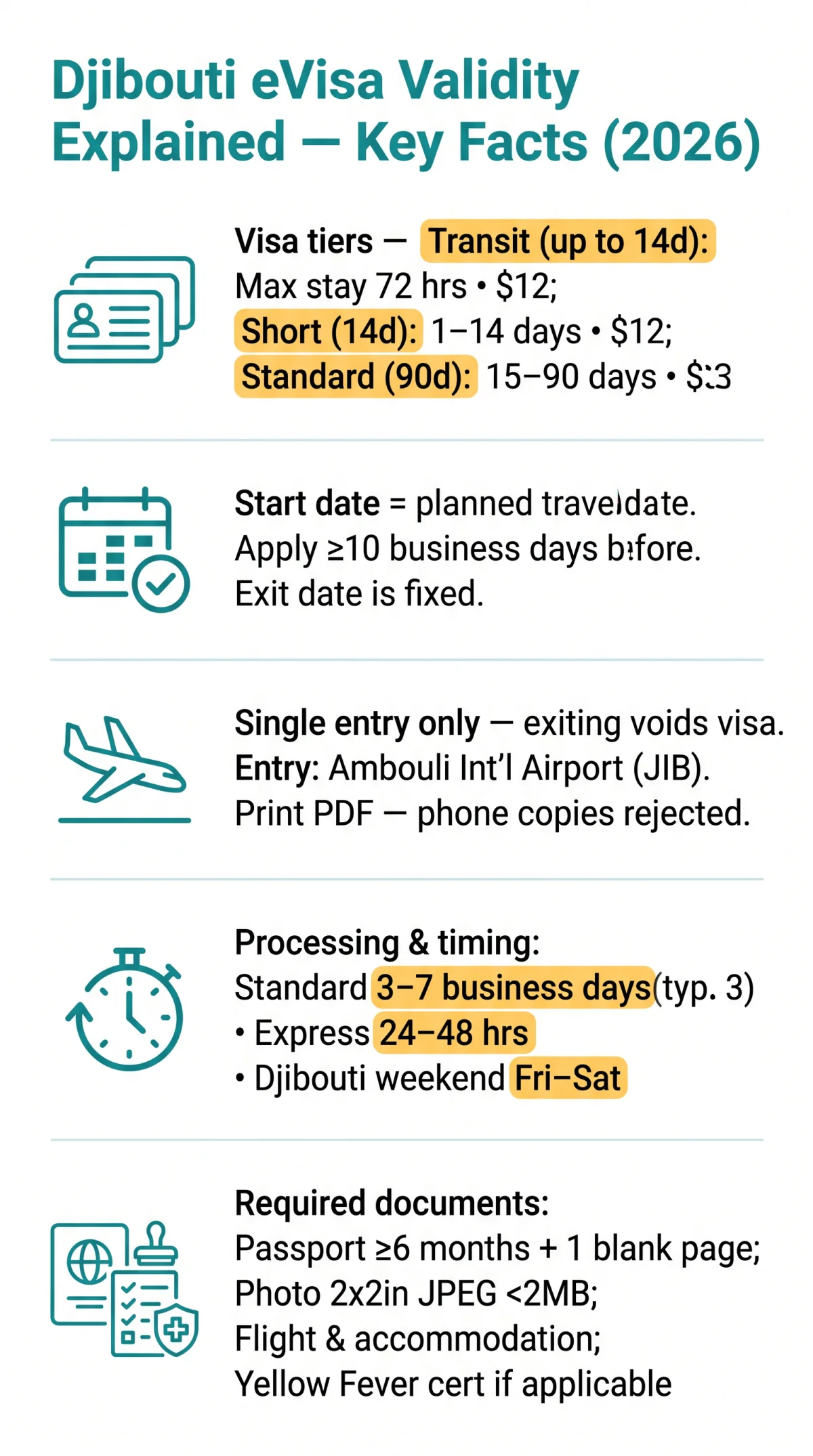
A Djibouti eVisa is single entry and valid for 14 or 90 days ($12/$23). Leaving Djibouti voids it regardless of remaining djibouti evisa validity. This guide covers validity windows, maximum stay durations, and entry rules for tourist, business, and transit visas for 2026.
What Is a Djibouti eVisa and How Long Is It Valid?
A Djibouti eVisa is a mandatory digital travel authorization for all foreign nationals, including UK citizens. The visa-on-arrival system was discontinued in May 2018; the eVisa system launched in February 2018. Applications are submitted at evisa.gouv.dj, the Republic of Djibouti’s eVisa portal. This guide is informational only and does not process applications.
| Visa Type | Validity Window | Max Stay | Entry Type | Fee (USD) |
|---|---|---|---|---|
| Transit | Up to 14 days | 72 hours | Single entry | $12 |
| Short-stay | Up to 14 days | 1-14 days | Single entry | $12 |
| Standard | Up to 90 days | 15-90 days | Single entry | $23 |
| Business | 14 or 90 days | 1-14 or 15-90 days | Single entry | $12/$23 |
| Student | Varies | Varies | Single or multiple | Not documented |
Djibouti eVisa validity ranges from 14 to 90 days depending on the tier. Some older sources (e.g., 2023 travel guides) reference a 31-day variant; cross-checking evisa.gouv.dj on 1 March 2026 confirmed only 14-day and 90-day tiers are available. Student eVisa validity and stay duration vary; limited data is available. Issuance of a Djibouti eVisa does not guarantee entry; final determination rests with the immigration officer at Ambouli International Airport.
When Does eVisa Validity Start?
According to the Republic of Djibouti’s eVisa guidelines (source: evisa.gouv.dj, accessed March 2026), Djibouti eVisa validity begins on the planned travel date entered in the application form, not the approval date. Two sources confirm this over one citing “date of issue.” Select a travel date that provides a buffer and apply at least 10 business days before departure.
Maximum Stay vs Validity Period: The Critical Difference
The validity period is your entry window; the maximum stay is the permitted duration inside Djibouti. The exit date declared on your application is fixed and does not shift if you enter later than planned.
Example: planned entry 15 March, exit 13 June; delayed arrival 1 April means you must leave by 13 June, reducing stay to 72 days. Late entry shortens stay proportionally; unused eVisa requires a new application. Maximum stay can never exceed the Djibouti eVisa validity window.
Single Entry Only: What It Means for Your Trip Planning
Every online Djibouti eVisa (tourist, business, or transit) is single entry: any exit voids it. If you are visiting Djibouti only and returning home, a single-entry eVisa is sufficient. If your itinerary involves crossing into Somaliland or Ethiopia and returning to Djibouti, you need two separate eVisa applications; the first visa is consumed when you exit.
Need Multiple Entries? Embassy Visa Options
Multiple-entry visas are not available through the eVisa portal at evisa.gouv.dj. Travellers requiring repeated entries must contact the Djibouti Embassy in London directly. Diplomatic passport holders are also excluded from the eVisa system and must apply through the embassy. Dual nationals should use the passport of nationality granting eVisa eligibility; if both are eligible, use the one with longer validity.
Transit and Business eVisa: Specific Rules and Entry Points
Transit eVisa ($12, onward-proof required) is for Ambouli International Airport (JIB) transit only, permitting a 72-hour (3-day) maximum stay; not for sightseeing. Business eVisa ($12/$23) covers meetings, conferences, negotiations, and training, never employment. Both are strictly single entry.
| Attribute | Transit eVisa | Business eVisa |
|---|---|---|
| Validity window | Up to 14 days | 14 or 90 days |
| Maximum stay | Up to 3 days (72 hours) | 1-14 or 15-90 days |
| Entry type | Single entry | Single entry |
| Government fee | $12 | $12 (14-day) / $23 (90-day) |
| Permitted activities | Airport transit only; onward proof required | Meetings, conferences, negotiations, training; no employment |
Entry with any Djibouti eVisa is restricted to Ambouli International Airport (JIB). Land border crossings such as Loyada (to Somaliland) and Galafi (to Ethiopia) are not confirmed entry points for eVisa holders. The portal at evisa.gouv.dj does not specify exit rules via land borders; UK travellers planning overland departures should confirm with the Djibouti Embassy. For UK government travel advice, consult GOV.UK’s Djibouti travel advice.
Processing Time, Delivery and Document Requirements
Standard processing takes 3-7 business days (typically 3 if documents complete); express delivers within 24-48 hours at an additional fee. Processing excludes Friday and Saturday (Djibouti weekend) plus public holidays. Apply at least 10 business days before departure. Accepted payment on evisa.gouv.dj includes American Express credit/debit cards; verify current methods before applying.
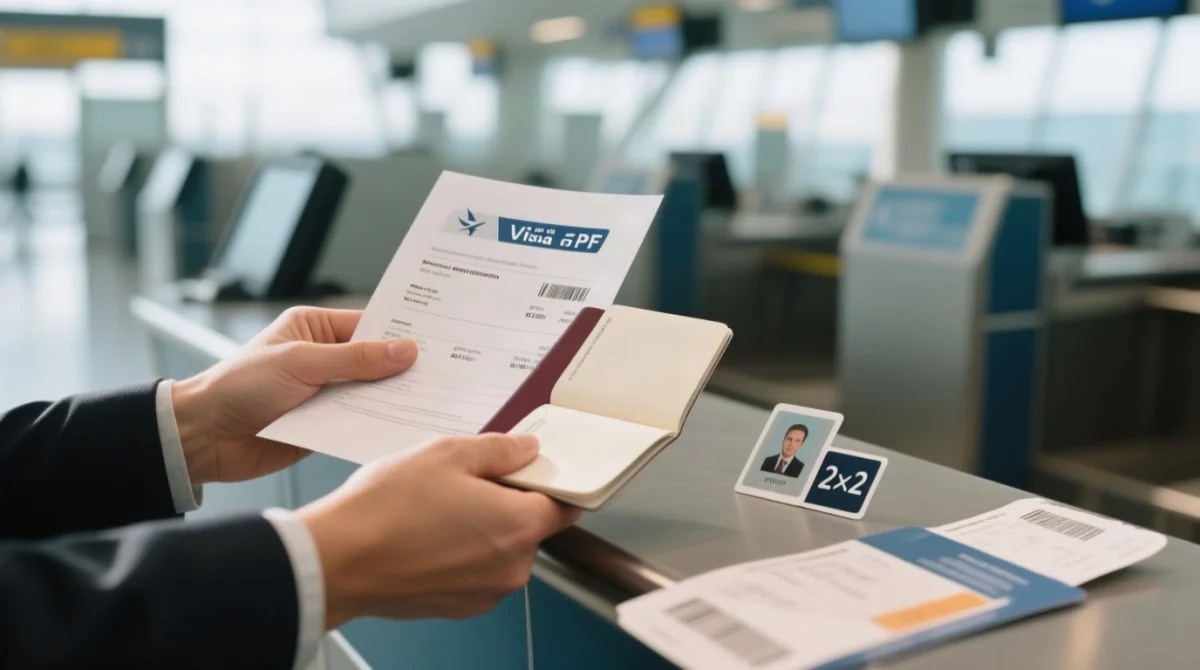
Djibouti eVisa validity starts on the application’s planned travel date, not the approval date. The emailed PDF must be printed; phone copies are rejected and airlines may deny boarding. Required documents: passport with 6 months validity beyond planned entry and 1 blank page; photo (2×2 inches, JPEG under 2 MB, white/light grey background, no glasses, neutral expression); flight reservation showing entry/exit dates; accommodation proof. A Yellow Fever Certificate is mandatory if arriving from or transiting a yellow fever endemic country; consult TravelHealthPro for medical guidance. Minimum financial means are not publicly documented.
Common rejection reasons: (1) blurry passport scan, (2) non-compliant photo, (3) passport validity under 6 months, (4) date mismatch between flight reservation and application, (5) payment failure. Government fees are non-refundable if denied. Reapply with corrected documents or contact the Djibouti Embassy. The Djibouti eVisa is linked to your passport number; changing passports requires a new application.
Overstay Consequences and Extending Your Stay
No overstay fine is publicly documented; risks include detention, fines, future visa problems, and deportation. No grace period exists. Contact local police before expiry and keep airline delay proof.
Extensions are reportedly possible through local police in Djibouti City, but the process is not standardized and approval is not guaranteed. Extension fees are not publicly documented. Cannot extend online; leave and reapply with a new fee. A more reliable strategy is selecting the 90-day Djibouti eVisa ($23) at application for maximum buffer. For emergency medical situations, contact your nearest embassy. Every Djibouti eVisa is single entry; exiting voids the current visa regardless of remaining validity.
Djibouti eVisa validity in 2026 depends on the visa type: tourist eVisas are valid for up to 90 days, business eVisas for 14 or 90 days, and transit eVisas for up to 14 days. All eVisas are single entry. Your maximum permitted stay is determined by the dates you select during application and cannot exceed the validity window.
FAQ
How long is a Djibouti tourist eVisa valid for in 2026?
90-day tier: $23, valid up to 90 days from planned travel date. 14-day tier: $12. Single entry.
What is the difference between eVisa validity and maximum stay?
Validity period = entry window. Maximum stay = permitted duration inside Djibouti. Stay cannot exceed the exit date on the application.
Can I enter Djibouti if my flight is delayed past my planned travel date?
Yes, any time within the validity window. The exit date does not change; delayed entry means shorter actual stay.
Is the Djibouti eVisa single entry or multiple entry?
All online Djibouti eVisas are single entry. Multiple-entry visas require application through a Djibouti embassy.
Do children need their own eVisa for Djibouti?
Yes. Every traveller regardless of age needs an individual eVisa. Children require a birth certificate and notarized parental consent letter if travelling without both parents.
What happens if I overstay my Djibouti eVisa?
No fixed fine is publicly documented. Risks include detention, discretionary fines, future visa difficulties, and deportation. No grace period exists.
Do I need to print my eVisa before travelling?
Yes. A printed copy is mandatory at airline check-in and Djibouti immigration. Airlines may deny boarding without one.
What passport validity do I need for a Djibouti eVisa?
At least 6 months beyond your planned entry date, with at least 1 blank page. Changing passports requires a new application.
How long does Djibouti eVisa processing take?
Standard: 3-7 business days (typically 3 if complete). Express: 24-48 hours at additional fee. Friday-Saturday excluded.
Can I extend my stay beyond the eVisa maximum?
Extensions are reportedly possible via local police in Djibouti City, but not standardized and not guaranteed. Apply for the longest tier from the start.
Can I enter Djibouti through a land border with an eVisa?
Ambouli International Airport (JIB) is the designated entry point. Land border eVisa acceptance is not confirmed; check with the Djibouti Embassy.
What are common reasons for Djibouti eVisa rejection?
Blurry passport scans, non-compliant photos, passport validity under 6 months, date mismatches, and payment failures. Fees are non-refundable if denied.