UK travellers need a visa for Djibouti in 2026. In the Djibouti eVisa vs visa on arrival comparison, the eVisa costs $23 USD online, processes in three business days, and eliminates airport queue risk. The visa on arrival is still available at Ambouli Airport for $30 USD cash, but carries airline boarding-denial risk.
Last reviewed: September 2026. Researched and maintained by an editorial team specialising in African entry requirements. Fees and processing times are subject to change; always confirm on the state portal before applying. This article contains no affiliate links and is purely informational.
Djibouti eVisa vs Visa on Arrival (2026): The eVisa costs $23 USD online and is processed within 3 business days, letting you skip the airport queue. The visa on arrival costs $30 USD cash at Djibouti-Ambouli Airport. UK travellers choosing the eVisa benefit from advance document screening, reducing the risk of a last-minute refusal at the border.
What Are the Djibouti eVisa and Visa on Arrival?
British passport holders must obtain a visa before entering Djibouti in 2026; there is no visa-free option. The Djibouti eVisa is a pre-approved online permit, while the visa on arrival is issued at Ambouli Airport immigration desks.
eVisa at a Glance: Introduced on 18 February 2018 to replace the visa on arrival system, the eVisa is processed through the state portal at evisa.gouv.dj. It delivers a PDF by email that must be printed and presented at any border crossing. Both the eVisa and visa on arrival grant single-entry tourist access. Eligible travel purposes include tourism, business, and family visits.
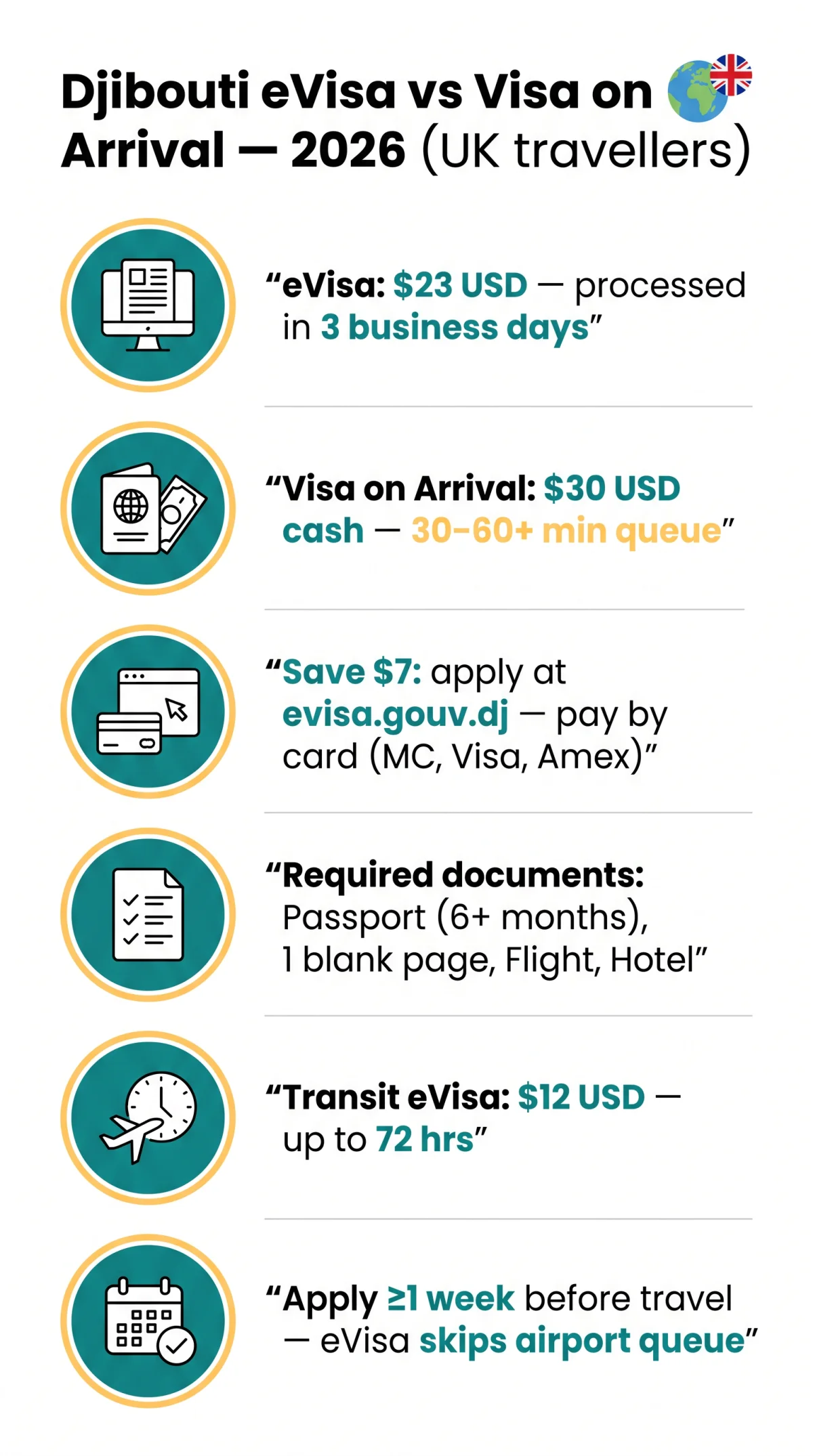
Visa on Arrival at a Glance: Still confirmed as available for ordinary UK passport holders per gov.uk, the visa on arrival is issued on-site as a full-page sticker and stamp at Ambouli International Airport (JIB). A transit eVisa costing $12 USD and allowing stays of up to 72 hours is also available for travellers passing through Djibouti without entering as tourists.
Cost Breakdown: Djibouti eVisa Fee vs Visa on Arrival Fee in 2026
The Djibouti eVisa costs $23 USD online versus $30 USD cash at the airport, though third-party agencies charge up to $73 USD. Applying directly through the state portal saves $7 USD compared to the visa on arrival, and $50 USD compared to third-party agencies.
The government eVisa fee of $23 USD is paid by card (Mastercard, VISA, or American Express) on the evisa.gouv.dj portal. A transit eVisa costs $12 USD. The visa on arrival requires $30 USD in cash USD only at Ambouli International Airport. Third-party agency sites charge up to $73 USD, which includes service surcharges rather than the government rate.
The eVisa fee is non-refundable if the application is rejected, meaning a rejected applicant who falls back to the visa on arrival pays twice. ATMs dispensing USD and Djibouti francs are available past immigration at Ambouli Airport.
| Fee Type | Djibouti eVisa | Visa on Arrival | Difference |
|---|---|---|---|
| Government fee | $23 USD (card) | $30 USD (cash) | $7 USD more for VOA |
| Transit option | $12 USD | Not available | eVisa only |
| Third-party rate | Up to $73 USD | N/A | Includes surcharges |
| Refund if rejected | Non-refundable | Non-refundable | Same policy |
Processing Time: Djibouti eVisa Approval vs Visa on Arrival Queue
The eVisa is processed in 3 business days (excluding Friday and Saturday, the Djiboutian weekend); the visa on arrival takes 30-60+ minutes depending on queue length at Ambouli Airport immigration desks. UK travellers should apply for the eVisa at least 1 week before travel to allow for the weekend and any portal delays.
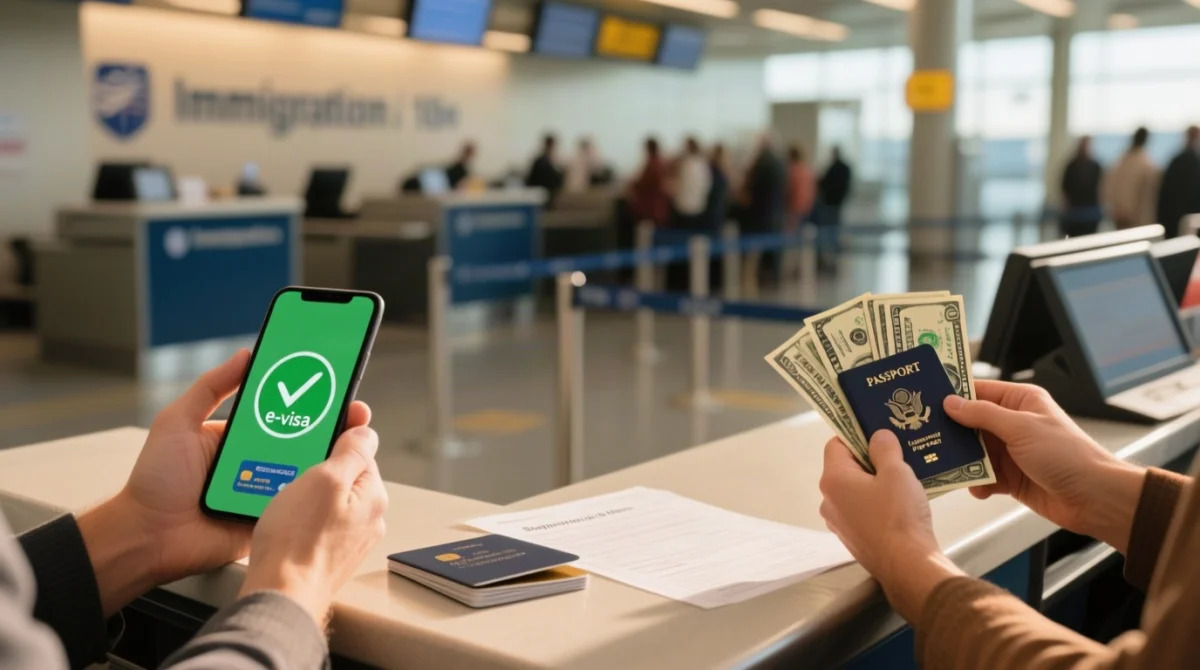
The eVisa application form takes several minutes to 1 hour to complete online. Status tracking is available via email notification or by checking the portal with a confirmation code. Post-submission changes are not permitted; incorrect data requires a new application. The eVisa suits planners: advance approval removes queue uncertainty and on-site document checks at the port of entry.
Required Documents for Djibouti eVisa vs Visa on Arrival
Both the Djibouti eVisa and visa on arrival require a passport valid at least 6 months after arrival, minimum 1 blank page, confirmed onward ticket, and accommodation confirmation. Accommodation dates must match flight reservation dates.
- eVisa-specific: digital passport scan (information pages), photo (white background, JPG/PNG), flight reservation (inbound + outbound), hotel booking with applicant’s name, optional invitation letter (host contact details, purpose, duration)
- VOA-specific: physical passport, cash USD only, same supporting documents presented in person at the immigration desk
- Yellow fever certificate: mandatory if arriving from a country listed as a transmission risk
Traveller reports indicate the eVisa portal occasionally experiences technical issues; applying early provides buffer time. Lost or stolen passports result in entry denial. British dual nationals must carry a valid British passport or certificate of entitlement when returning to the UK.
Convenience Compared: Djibouti eVisa vs Visa on Arrival for UK Travellers
The eVisa eliminates the airport queue: travellers apply from home via evisa.gouv.dj, upload documents, pay by card, and receive a PDF to print before departure.
Visit the eVisa portal
Go to evisa.gouv.dj and click “I wish to make a new request”
Fill the form
Fill the form and upload required documents
Submit and pay
Submit and pay by card (Mastercard, VISA, American Express)
Receive approved PDF
Receive approved PDF via email; print and carry with passport
The visa on arrival requires travellers to fill an arrival card, queue at the “Visa On Arrival” desk, present physical documents, pay cash, and receive a passport sticker and stamp from the immigration officer. Families with children benefit from the eVisa’s pre-departure certainty, while last-minute travellers may need the visa on arrival. The eVisa PDF is valid at all border crossings, not just Ambouli Airport.
Risk of Refusal: Can You Be Denied Entry with a Djibouti eVisa or Visa on Arrival?
eVisa Refusal Scenarios: An eVisa application can be rejected during screening for data errors, passport validity under 6 months, or document mismatches. The $23 USD fee is non-refundable. Post-submission changes are not permitted; applicants must submit a new application or visit the nearest Djibouti embassy or consulate.
Visa on Arrival Refusal Scenarios: If the visa on arrival is refused at the border by an immigration officer, the traveller faces an immediate return flight with no on-site appeal. The $30 USD fee is not refunded.
How to Reduce Your Risk: Airlines use Timatic databases and may deny boarding without a pre-approved visa, even if the visa on arrival is technically available on arrival. This is the single biggest risk for UK travellers choosing the visa on arrival only. Apply for the eVisa at least 1 week ahead, carry all supporting documents, and ensure passport validity exceeds 6 months. The FCDO advises against all travel to parts of Djibouti; consult gov.uk for current travel advice.
Side-by-Side Comparison Table: Djibouti eVisa vs Visa on Arrival (2026)
A direct comparison across cost, processing time, documents, convenience, and refusal risk shows the eVisa is safer and similarly priced for most UK travellers. The eVisa costs $23 USD online versus $30 USD cash at the border, with advance screening that removes on-site refusal risk.
| Feature | Djibouti eVisa | Visa on Arrival |
|---|---|---|
| Cost | $23 USD (card) | $30 USD (cash) |
| Processing time | 3 business days (excl. Fri-Sat) | 30-60+ min (queue-dependent) |
| Payment | Card (MC, Visa, Amex) | Cash USD only |
| Validity | 31-90 days | Issued at border |
| Max stay | 14-31 days (short tourist) | Officer discretion |
| Required docs | Digital passport scan, photo, flight + hotel proof | Physical passport, cash, flight + hotel proof |
| Convenience | Apply from home; skip airport queue | No pre-travel admin; queue at airport |
| Refusal risk | Low (pre-screened); fee non-refundable if rejected | Higher (on-site decision); no appeal |
- Costs less ($23 vs $30 USD)
- Processed in 3 business days
- Apply from home, skip airport queue
- Pre-screened, reducing refusal risk
- Non-refundable if rejected
- Cannot edit after submission
- Must apply at least 1 week before travel
The visa on arrival only suits last-minute travellers.
UK Traveller Verdict: Djibouti eVisa or Visa on Arrival?
UK travellers planning ahead should choose the eVisa; only last-minute travellers should rely on the visa on arrival.
Choose the Djibouti eVisa if: you are planning at least 1 week ahead, travelling with family, visiting East Africa for the first time, or want pre-departure certainty. The eVisa costs $23 USD paid by card and processes in 3 business days, eliminating the airline boarding-denial risk that Timatic-based check-in systems pose to passengers without pre-approved documentation.
Choose the visa on arrival if: you are travelling last-minute, experienced with African border procedures, and comfortable carrying exact $30 USD cash to Ambouli Airport. Note that photography is strictly prohibited near military base locations in Djibouti, and drone cameras risk confiscation by authorities.
In doubt? Choose the Djibouti eVisa. It costs less, removes border uncertainty, and guarantees approval before you board. Apply via the eVisa portal (external source) and consult gov.uk entry requirements for current FCDO travel advice.
FAQ: Djibouti eVisa vs Visa on Arrival
Do UK citizens need a visa for Djibouti in 2026?
Yes, a visa is mandatory for British citizens travelling to Djibouti in 2026. There is no visa-free option. UK passport holders must choose between an eVisa online before departure or a visa on arrival at Djibouti Ambouli International Airport.
How much does the Djibouti eVisa cost for UK passport holders?
The Djibouti eVisa costs $23 USD when applying directly through the state portal. Third-party agency sites charge up to $73 USD, which includes service surcharges but is not the government rate. A transit eVisa is also available for $12 USD.
What is the Djibouti visa on arrival fee at the airport?
The Djibouti visa on arrival fee is $30 USD, payable in cash only. US dollars are the exclusively accepted currency at Ambouli International Airport immigration desks. Card payments are not accepted for the visa on arrival.
How long does the Djibouti eVisa take to process?
The standard processing time for the Djibouti eVisa is 3 business days. This excludes Friday and Saturday, which constitute the Djiboutian weekend. It is recommended to apply at least 1 week before travel to ensure you receive the approved PDF via email in time.
Can you be denied entry to Djibouti with a valid eVisa?
Yes, an eVisa application can be rejected during the screening process if there are data errors, passport validity under 6 months, or document mismatches. If rejected, the $23 USD fee is non-refundable. You cannot edit a submitted application and must re-apply or visit an embassy.
What documents do I need for a Djibouti visa on arrival?
For a visa on arrival, you need a valid physical passport with at least 6 months validity and 1 blank page, proof of onward journey, and confirmed hotel reservations. You must also bring $30 USD in cash to pay the fee at the immigration desk.
Is the Djibouti eVisa better than the visa on arrival for tourists?
For most UK tourists, the eVisa is the better option. It costs less ($23 vs $30), allows you to skip the airport queue, and eliminates the risk of airlines denying boarding based on Timatic checks. The visa on arrival is only preferable for last-minute travel.
How long is the Djibouti tourist eVisa valid for?
The Djibouti tourist eVisa is valid for 31 days from the selected date of entry (short option) or up to 90 days (long option). The short-stay option permits a maximum stay of up to 14 days, while the long option permits up to 31 days. Both are single-entry.
Can I pay for a Djibouti visa on arrival by card?
No. The visa on arrival at Ambouli International Airport accepts cash USD only. Card payments are not accepted. ATMs dispensing USD and Djibouti francs are available past immigration, but you must have the exact $30 USD cash before reaching the immigration desk.
What happens if my visa on arrival is refused at the border?
If your visa on arrival is refused at the border by an immigration officer, you will not receive a refund for the $30 fee. You will be required to take an immediate return flight, as there is no on-site appeal process available at the airport.