UK passport holders need a visa to enter Djibouti. You can apply through the government’s online eVisa system or via a traditional Djibouti embassy visa. The eVisa costs $12 to $23 USD with 1 to 3 business days processing, while embassy visas cost $85 to $113 USD and cover additional purposes such as work and study.
The Djibouti government recommends the eVisa route, introduced on 18 February 2018 to replace the visa-on-arrival system. The eVisa is limited to tourism and commerce, is single-entry only, and is valid for entry through Ambouli International Airport. The embassy route offers multiple-entry visas valid for up to 6 months and supports a broader range of travel purposes. Last reviewed: 9 September 2026.
This comparison covers costs, speeds, documents, and when each option suits UK travellers in 2026.
What Is the Difference Between a Djibouti eVisa and an Embassy Visa?
The Djibouti eVisa is a 100% online application submitted via evisa.gouv.dj, with the approved visa delivered by email as a PDF. A Djibouti embassy visa requires physical submission of documents, in person or by post, at a Djibouti diplomatic mission. The eVisa covers tourism and commerce only; the embassy visa covers work, study, long-term stays, and any non-eVisa purpose. UK passport holders need a visa for Djibouti regardless of route. VisaHQ UK (visahq.co.uk, +44 204 577 3307, [email protected], available 7 days a week) offers agency-assisted eVisa filing for UK applicants.
The Djibouti eVisa does not entitle the holder to automatic admission: the immigration officer at the port of entry makes the final decision. Denials are extremely rare. The eVisa validity period starts from the date of entry into Djibouti. Official business days in Djibouti run Sunday through Thursday.
Djibouti eVisa vs Embassy Visa – Full Comparison Table
| Attribute | Djibouti eVisa | Djibouti Embassy Visa |
|---|---|---|
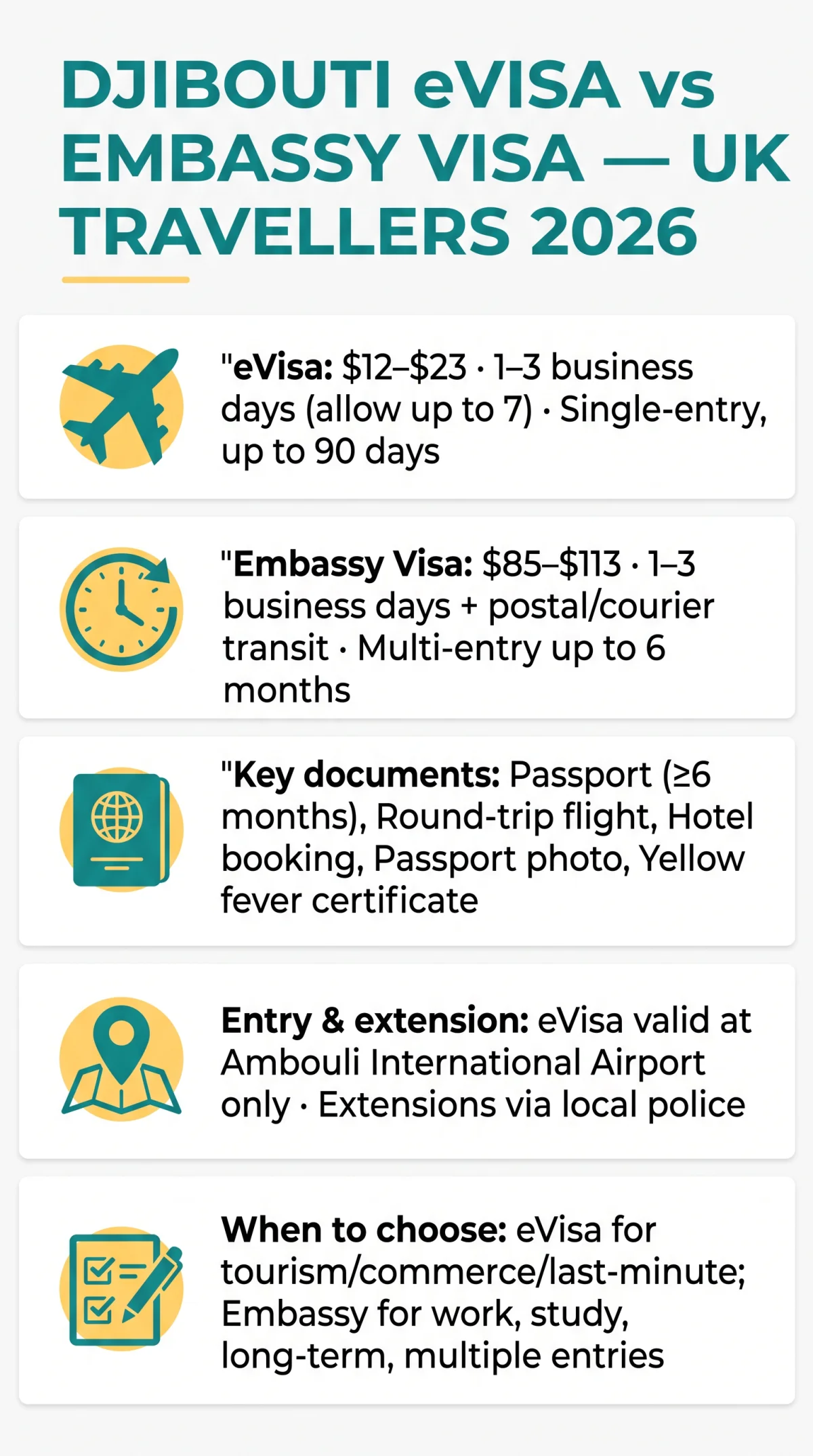
| Government fee | $12 USD (14-day) / $23 USD (90-day) | $85-$113 USD (varies by nationality and country of application) |
| Total real-world cost | $12-$23 DIY; add €50 service fee if using an agency | $85-$113 plus travel to embassy and postage costs |
| Processing time | 1-3 business days (allow up to 7 as safe margin) | 1-3 business days at embassy, plus postal/courier transit for UK applicants |
| Visa validity | Single entry, up to 90 days (valid from date of entry) | Single entry up to 90 days, or multi-entry up to 6 months |
| Permitted purposes | Tourism and commerce only | Work, study, long-term stays, and any non-eVisa purpose |
| Entry point | Ambouli International Airport | Any border crossing |
| Extension | Local police permit required | Multi-entry validity up to 6 months |
- Cheaper ($12-$23)
- Equally fast (1-3 business days)
- Single entry only
- Tourism and commerce only
- Entry via Ambouli International Airport only
- Embassy visa required for work, study, long-term stays, or multiple entries up to 6 months
How Much Does a Djibouti Visa Cost – eVisa vs Embassy Route
Government fees: $12 USD (14-day) and $23 USD (90-day) eVisa rates at evisa.gouv.dj; $85-$113 USD for the Djibouti embassy visa, varying by nationality and country of application.
| Cost Factor | Djibouti eVisa | Djibouti Embassy Visa |
|---|---|---|
| Government fee | $12 USD (14-day) / $23 USD (90-day) | $85-$113 USD (varies by nationality & application country) |
| Agency service fee | €50 EUR (e.g. netafri.com); VisaHQ fee undisclosed (states “no hidden fees”) | Not applicable (direct embassy filing) |
| Accepted payment | Bank transfer, UnionPay | Money order, company check, or cash only; credit cards & personal checks NOT accepted |
| Indirect costs | None (fully online) | Travel/postage to embassy; possible trip to neighbouring country if no mission in the UK |
| Cheapest total (DIY) | $12-$23 USD | $85+ USD plus indirect travel/postage costs |
Add €50 if using an agency for the eVisa. VisaHQ UK (+44 204 577 3307, [email protected]) does not disclose its service fee but states “no hidden fees” and uses encryption technology. With no confirmed Djibouti embassy in the UK, the embassy route also adds postage or travel to a neighbouring country, and payments are restricted to money order, company check, or cash; no credit cards.
How Long Does Processing Take – eVisa vs Embassy Compared
Both routes process in 1-3 business days, but the Djibouti eVisa delivers approval by email with no transit delay, while the Djibouti embassy visa adds postal or courier transit that can extend the total wait to several weeks for UK applicants. The eVisa form takes under 5 minutes to complete; apply at least 3 days before travel. Expedited eVisa processing can return approval within 24 hours (per netafri.com). Some travellers report 7-day waits despite the advertised 1-3 day window; allow up to 7 business days as a safe margin.
| Factor | Djibouti eVisa | Djibouti Embassy Visa |
|---|---|---|
| Standard processing | 1-3 business days (allow up to 7 as safe margin) | 1-3 business days at embassy; postal transit adds days or weeks |
| Expedited option | Within 24 hours (per netafri.com) | Dependent on embassy capacity |
| Form completion | Under 5 minutes; apply at least 3 days before travel | Physical form; in-person or postal submission |
What Documents Do You Need – eVisa vs Embassy Visa
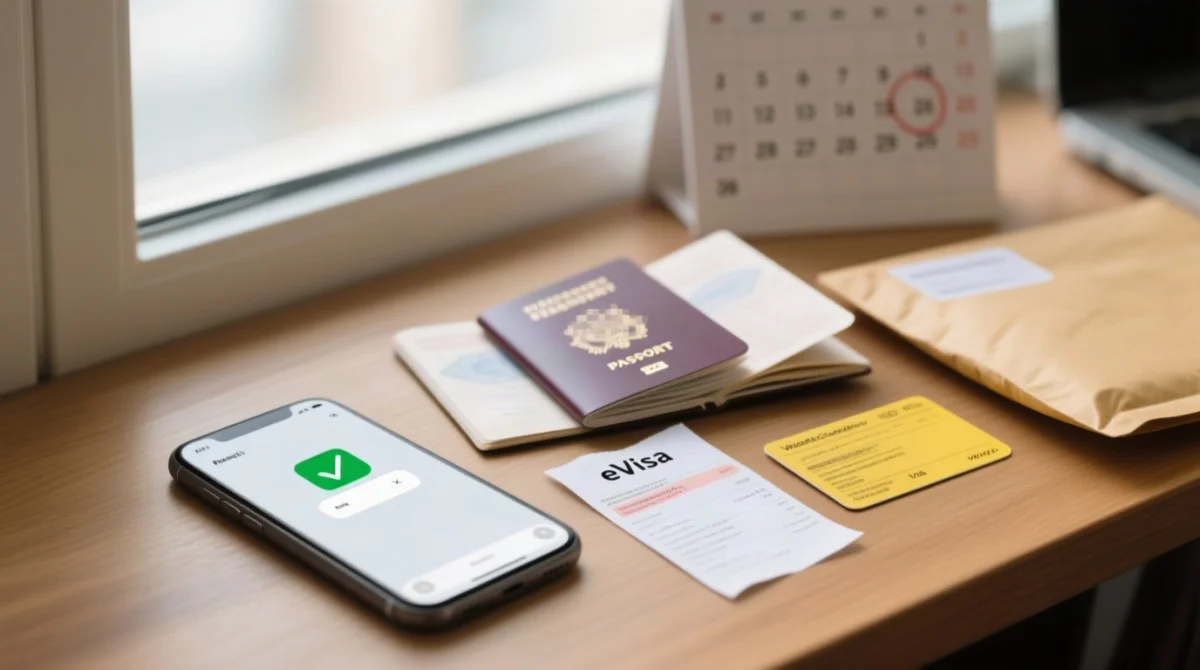
Both the Djibouti eVisa and the Djibouti embassy visa require a valid signed passport with 6 months minimum remaining validity from the arrival date, a round-trip flight reservation, a confirmed hotel booking with the applicant’s name, and a passport-style photo (white background; PNG format for eVisa). The eVisa requires all documents uploaded digitally, a yellow fever vaccination certificate, and a printed copy of the eVisa carried at all times. The embassy visa requires the original passport for physical submission, confirmation of accommodation (tourist), an official invitation letter from the firm or group (business), or an original invitation from a Djibouti-based firm (employment). Visiting friends or family under either route requires a copy of the host’s Djibouti ID.
| Requirement | Djibouti eVisa | Djibouti Embassy Visa |
|---|---|---|
| Shared documents | Valid signed passport (6 months minimum from arrival), round-trip flight reservation, confirmed hotel booking, passport-style photo (white background; PNG for eVisa) | |
| Route-specific | All uploaded digitally; yellow fever vaccination certificate; print eVisa and carry at all times; present passport + printed eVisa + all submitted documents on arrival | Original passport (physical); accommodation confirmation (tourist); official invitation letter (business); original invitation from Djibouti-based firm (employment) |
| Personal visit (friends/family) | Copy of host’s Djibouti ID required under either route | |
When to Choose the eVisa vs the Embassy Visa
Choose the Djibouti eVisa for tourism/commerce under 90 days; choose the Djibouti embassy visa for work, study, long-term stays, or multiple entries. Visa on arrival was discontinued for ordinary passport holders in May 2018.
- Standard tourist trip under 90 days → Djibouti eVisa. Cheapest at $12 (14-day) or $23 (90-day), fastest at 1-3 business days, fully online with no embassy visit.
- Short business or commerce visit → Djibouti eVisa. Commerce is a permitted eVisa purpose.
- Work or study in Djibouti → Djibouti embassy visa. The eVisa covers tourism and commerce only.
- Multiple entries within 6 months → Djibouti embassy visa. The embassy route offers multi-entry validity up to 6 months.
- Last-minute travel (under 3 days) → Djibouti eVisa. Expedited processing can return approval within 24 hours.
- No Djibouti embassy in your country of residence → Djibouti eVisa. The application is 100% online, so UK applicants avoid travelling to a neighbouring mission.
- Stay beyond 90 days → Djibouti embassy visa for initial authorisation. eVisa holders already in-country may extend through local police with an extension permit.
Example: A UK tourist visiting Djibouti City for 10 days would pay $12 via the Djibouti eVisa and receive approval in 2 days; a UK teacher on a 6-month contract would need the Djibouti embassy visa at $113 plus postage, because the eVisa authorises tourism and commerce only.
Djibouti eVisa vs Embassy Visa: FAQ
Can I still get a visa on arrival in Djibouti?
Visa on arrival was discontinued for ordinary passport holders on 1 May 2018. The Government of Djibouti recommends applying for an eVisa instead. Some travellers report obtaining a visa on arrival at the airport for $30 USD, and airline databases such as Timatic may still list it as available, but this is unreliable and should not be your primary plan.
Do I need a yellow fever vaccination for Djibouti?
Yes. A yellow fever vaccination certificate is required when applying for the Djibouti eVisa.
Can I extend my Djibouti eVisa once I’m in the country?
Yes. The Djibouti eVisa can be extended through the local police, which requires an extension permit. Contact local police authorities for the specific procedure and required documentation.
Is there a Djibouti embassy in the UK?
No Djibouti embassy or consulate is confirmed in the United Kingdom. UK-based applicants may need to apply via postal submission to the nearest Djibouti diplomatic mission abroad or in a neighbouring country, adding transit time and travel costs compared to the fully online eVisa route.
Which entry points accept the Djibouti eVisa?
The Djibouti eVisa is accepted at Ambouli International Airport as the confirmed primary entry point. If you plan to enter Djibouti by land or sea, verify entry requirements with Djibouti immigration authorities before travel.
What payment methods are accepted for each visa route?
eVisa: bank transfer or UnionPay. Embassy: money order, company check, or cash in person; credit cards and personal checks are not accepted.
How reliable is the Djibouti eVisa online system?
Some travellers report issues with the eVisa portal, including not receiving the visa after paying the fee and delays of up to 7 business days despite the advertised 1-3 day processing time. Apply at least 3 days before travel and allow up to 7 business days as a safe margin.
Is the Djibouti eVisa single-entry or multiple-entry?
The Djibouti eVisa is single-entry only. A multiple-entry visa valid for up to 6 months requires the embassy route.