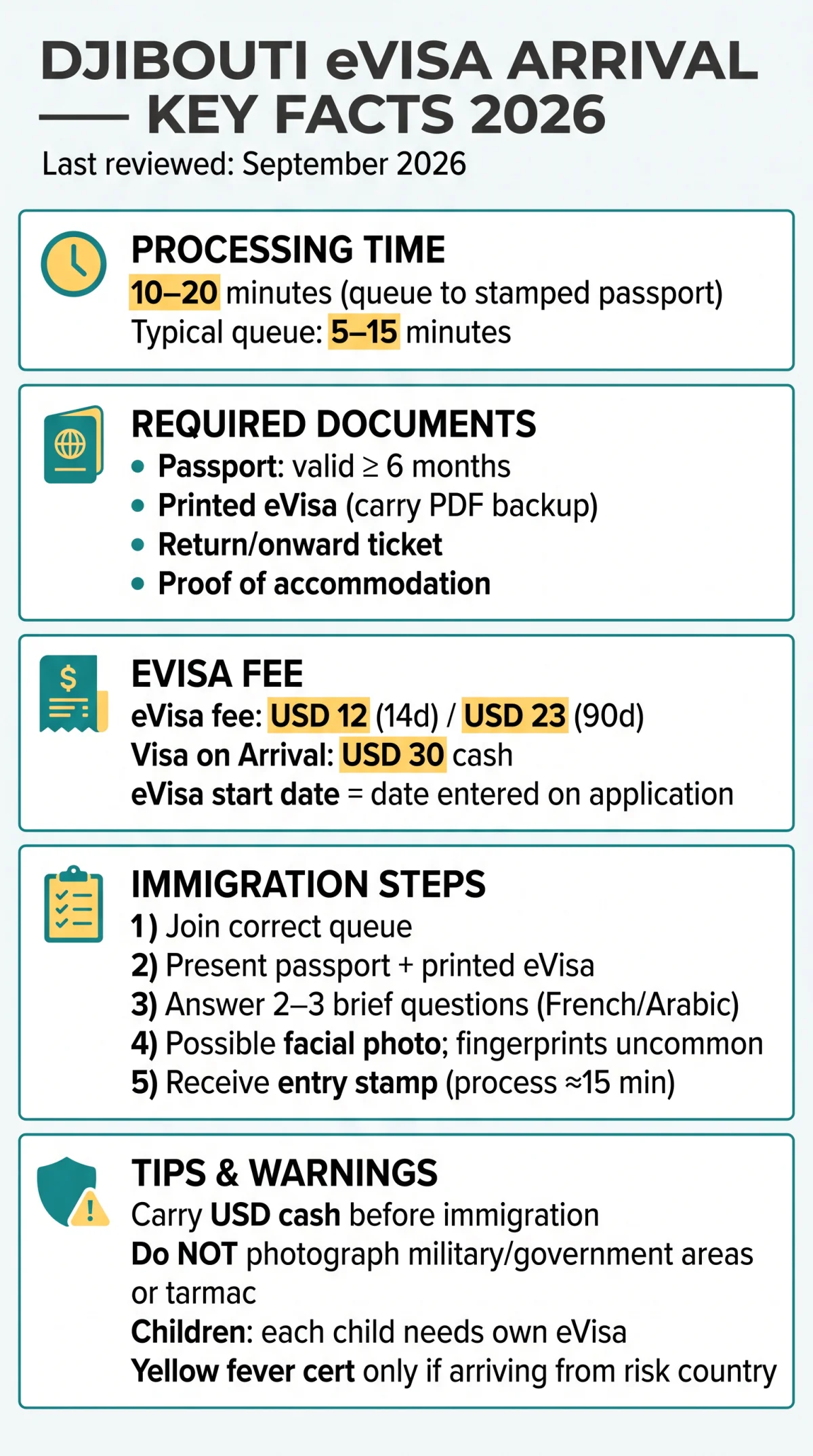
Last reviewed: September 2026. The Djibouti eVisa arrival process at Ambouli International Airport takes 10 to 20 minutes from queue to stamped passport. Present your printed eVisa and a passport valid for at least six months at the immigration counter. Biometric fingerprinting is not systematic, but expect a possible facial photograph. Officers speak French and Arabic with limited English, so keep your hotel booking and return ticket ready for the brief interview.
Arriving at Ambouli International Airport and Documents to Present
Ambouli International Airport sits 5 km from Djibouti City centre. Passengers disembark onto the tarmac and transfer to a compact immigration hall where terminal Wi-Fi is unreliable. Whether arriving by air at Ambouli or by land border (Loyada from Somaliland, Galafi corridor from Ethiopia), the core Djibouti eVisa arrival process steps remain similar: document presentation, brief interview, and stamp issuance. You must present a passport valid for at least 6 months (confirmed by GOV.UK), a printed eVisa, a confirmed return or onward ticket, and proof of accommodation.
| Document | Required? | Notes |
|---|---|---|
| Passport | Yes | Valid ≥ 6 months. Name must match eVisa (machine-readable line). |
| Printed eVisa confirmation | Yes | Paper copy often required; airport Wi-Fi unreliable. |
| Confirmed return or onward ticket | Yes | Airlines may refuse boarding without it. |
| Proof of accommodation | Yes | Hotel booking (with applicant’s name) or invitation letter with host ID. |
| Yellow fever vaccination certificate | Conditional | Mandatory only when arriving from a risk country. Check TravelHealthPro. |
The eVisa validity start date is the same date entered on your application form, not your actual arrival date. Arriving later does not postpone expiry. The Djibouti eVisa arrival process cannot be completed with a digital copy alone if immigration computers cannot retrieve your record by passport number.
Why a Paper eVisa Printout Matters
Ambouli’s arrival hall internet connection is problematic, and officers may not look up eVisas by passport number in real time. Carry a printed copy plus a backup PDF on your phone.
Documents for Children and Minors
Each child needs an individual eVisa tied to their own passport. Unabridged birth certificates are recommended for all minors, and parental consent letters are required when a child travels alone or with only one parent.
Step-by-Step at the Immigration Counter
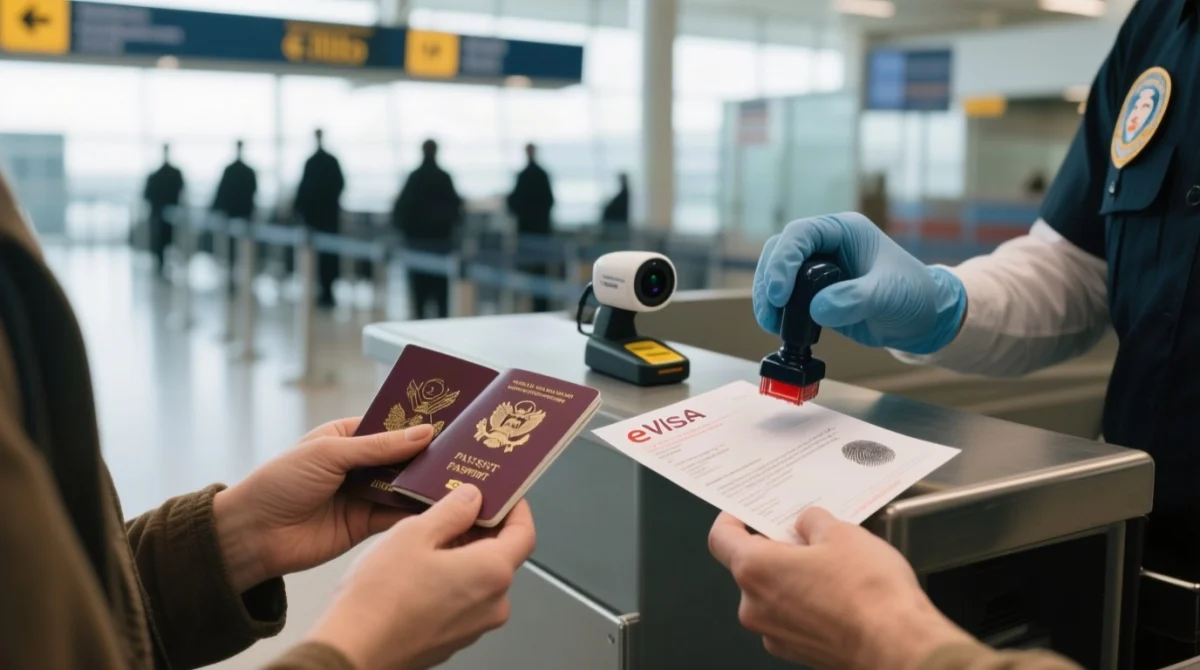
The Djibouti eVisa arrival process requires you to present your passport and printed eVisa at the counter, answer two or three brief questions in French or Arabic, and receive an entry stamp, typically in under 15 minutes. Traveller reports from mid-2025 confirm typical processing times of 10 to 15 minutes with only two or three questions asked.
Join the correct queue
Ambouli is small; signage separates eVisa holders from Visa on Arrival applicants. Expect a 5 to 15 minute wait.
Present documents simultaneously
Hand over your passport (photo page) and printed eVisa together. The officer checks the name matches the machine-readable line.
Answer the interview
Officers predominantly speak French and Arabic; English is limited. Common questions: “Where will you be staying?”, “How long do you plan to stay?”, “What is the purpose of your visit?”
Comply with additional checks
Officers may request travel insurance details or contact information for your host or hotel in Djibouti.
Receive your entry stamp
The Djibouti eVisa arrival process concludes here. Keep the eVisa printout safe as departure immigration may re-check it.
Biometrics at Djibouti Immigration
The Djibouti eVisa arrival process does not systematically collect biometric fingerprints or iris scans from tourists at Ambouli, a notable difference from Gulf-state neighbours. A facial photograph may be taken at the counter for the visa sticker. Fingerprint readers exist but usage is inconsistent and not mandatory for all nationalities. When biometrics are collected, the process takes under 2 minutes.
ICAO and African Union frameworks may expand biometric enrolment in Djibouti. Check the Djibouti Ministry of Interior portal before travel. The Djibouti eVisa arrival process may involve different biometric procedures at overland crossing points versus Ambouli Airport.
After Passport Control: Customs, Baggage, and Exit Formalities
After the Djibouti eVisa arrival process concludes with your entry stamp, you proceed to baggage claim, customs inspection, and the airport exit where specific restrictions apply.
- Baggage claim: small carousel; photograph your tag in case of loss.
- Customs declaration: random inspections include carry-on luggage. Declare any goods subject to tax or duty.
- Restricted items: drones, professional cameras, and satellite equipment face heightened scrutiny due to multiple foreign military bases (French, US, Chinese, Japanese, Italian, German, Spanish). Confiscation is possible without permits.
- Photography ban: photographing military installations, government buildings, the immigration area, or the tarmac is prohibited and carries serious penalties.
- Health screening: thermal scans and health declaration forms may be in use. Yellow fever vaccination certificates are checked here when arriving from a risk country. Consult TravelHealthPro before departure.
- Medication: must be in original packaging; an English-language certificate is recommended.
- ATMs and exchange: available only after passport control; machines dispense USD and Djiboutian francs (DJF). Bring USD cash for initial expenses, as no exchange facilities exist before immigration.
eVisa vs Visa on Arrival and Tips for a Smooth Crossing
The Djibouti eVisa arrival process is faster than Visa on Arrival. UK passport holders can buy a USD 30 VoA at Ambouli, but a pre-approved eVisa shortens the queue and reduces document scrutiny.
| Feature | eVisa | Visa on Arrival |
|---|---|---|
| Fee | USD 12 (14-day) / USD 23 (90-day) | USD 30 (cash, US dollars) |
| Processing | Pre-approved; 3 to 7 business days (Sun-Thu) | On-the-spot; longer queue |
| Format | Email PDF; print before travel | Full-page sticker + stamp |
| Scrutiny | Standard | More extensive |
General tourist VoA was discontinued in May 2018; it remains for diplomatic, service, and official passport holders (courtesy visa for UN, AU, AfDB, COMESA, and military personnel). A transit eVisa allows a maximum stay of 72 hours at Ambouli with proof of onward departure. UK travellers are eligible for both; the eVisa is recommended.
If your eVisa was not received, check spam and contact the official Djibouti eVisa portal at evisa.gouv.dj (allow 3 to 7 business days, Sunday through Thursday). Overstays require an extension permit from local police in Djibouti City. The Djibouti eVisa arrival process depends on having valid documentation, so carry a backup PDF if your printout is lost.
FAQ: Djibouti eVisa Arrival Process
Do I need to print my Djibouti eVisa, or is a digital copy enough?
A printed copy is strongly recommended because airport Wi-Fi is unreliable. Always carry a printed copy plus a backup PDF on your phone.
How long does the Djibouti eVisa arrival process take at the airport?
Typically 10 to 20 minutes: 5 to 15 minute queue, document check, brief interview, stamp. Peak arrival hours extend waiting.
What questions does the immigration officer ask during the Djibouti eVisa arrival process?
Same questions as in the counter walkthrough: accommodation, stay duration, purpose. French/Arabic, limited English. Have your hotel address written down.
Do I need a yellow fever vaccination certificate to enter Djibouti?
Only if arriving from a yellow fever transmission risk country. Check TravelHealthPro before departure and carry the original certificate.
Can I use a Djibouti eVisa to cross a land border from Ethiopia or Somaliland?
Yes. The eVisa is accepted at all border crossings, including Galafi from Ethiopia and Loyada from Somaliland. Carry the same documents as at the airport.
What happens at Djibouti immigration if my passport expires within six months?
You will be denied entry. The Djibouti eVisa arrival process strictly enforces the 6-month passport validity rule. The UK FCDO confirms this is non-negotiable. Renew before applying.
Can children travel on a parent’s Djibouti eVisa?
No. Each child requires an individual eVisa tied to their own passport. Carry unabridged birth certificates and parental consent letters when applicable.
Do UK passport holders need an eVisa or can they get a visa on arrival?
UK passport holders can do both. VoA costs USD 30 cash at Ambouli. A pre-approved eVisa costs USD 12 or USD 23, shortens the queue, and reduces scrutiny.
Is there Wi-Fi or mobile data at Ambouli International Airport?
Terminal Wi-Fi at Ambouli is unreliable. Mobile data depends on your UK carrier’s roaming agreements. Consider a local SIM or eSIM. Always carry a printed eVisa copy.
What should I do if my eVisa printout is lost or damaged in transit?
Carry a backup PDF on your phone. Some officers may look up the eVisa by passport number, but this is not guaranteed. Ask your hotel or an airport business centre for emergency printing.