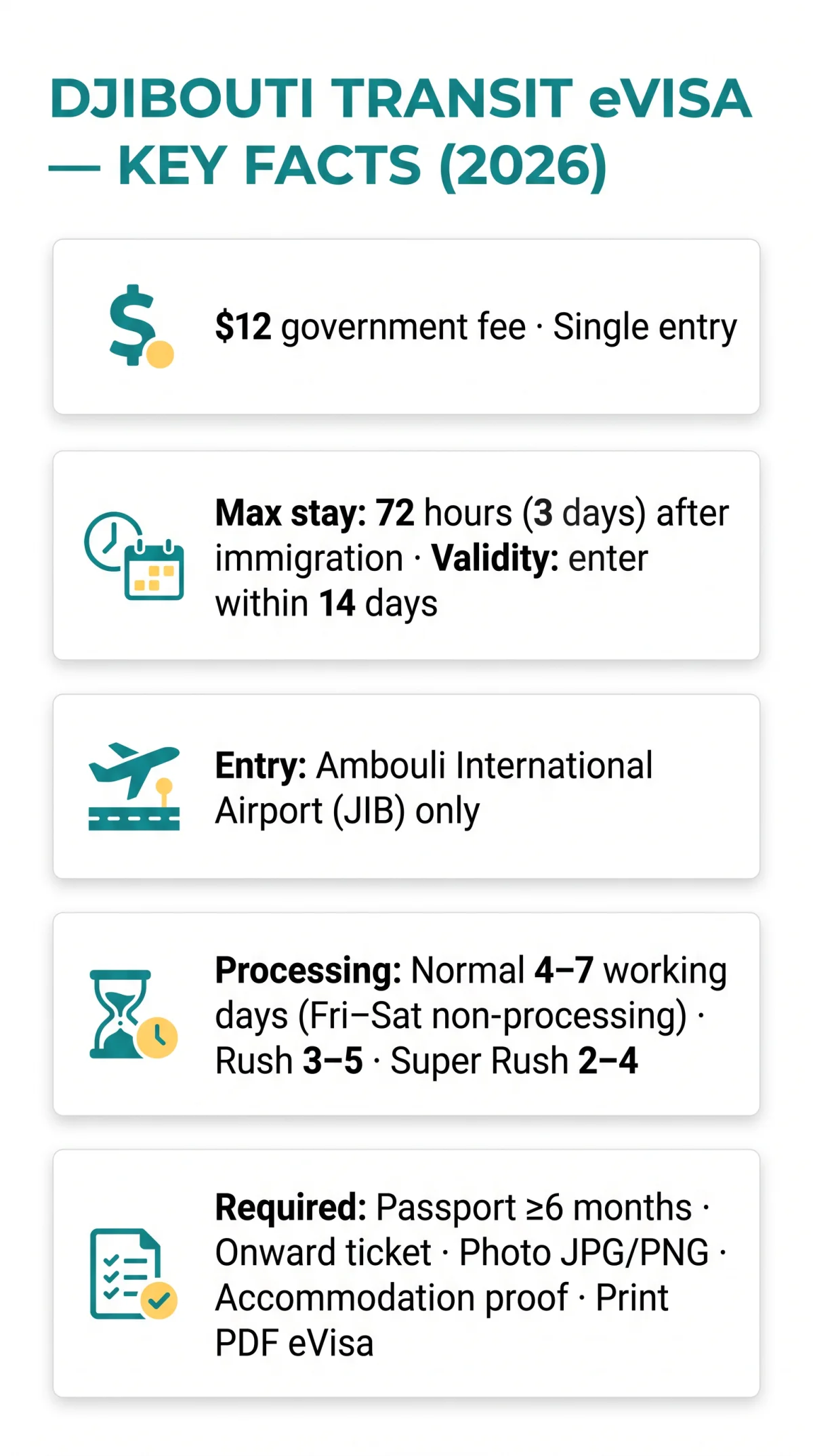
Djibouti eVisa transit visa rules set a $12 government fee, single entry, and a maximum stay of 72 hours within a 14-day validity window. The visa applies only at Ambouli International Airport and does not allow employment. Sightseeing during a layover is permitted.
The transit eVisa is structurally tied to flight connections at Ambouli International Airport. If you remain in the transit area without passing immigration, a transit visa is not required. Leaving the airport transit zone necessitates obtaining the transit eVisa prior to travel.
The eVisa system replaced the visa on arrival in February 2018, making pre-departure applications mandatory. Standard processing takes 4-7 working days (excluding Friday and Saturday); ensure your passport is valid for 6 months after arrival and carry a printed eVisa.
Last reviewed: September 2026. Verified against evisa.gouv.dj guidelines and FCDO travel advice. The government may adjust fees, eligibility, or processing times without notice – always verify requirements at evisa.gouv.dj before travel.
What Is the Djibouti Transit eVisa?
The Djibouti transit eVisa is a single-entry visa for travellers connecting through Djibouti to a third country, valid for 14 days from the intended arrival date with a maximum permitted stay of 72 hours (3 days) once immigration is passed.
The Djibouti transit eVisa has a two-layer time structure: a 14-day validity window (entry deadline – you must enter within 14 days from the intended arrival date) and a 72-hour stay limit starting exactly when you pass immigration at Ambouli International Airport. Overstaying triggers fines, detention, or re-entry bans. The base government fee is $12 USD, and entry is restricted to Ambouli International Airport only. No other port of entry accepts this visa category.
Djibouti launched its eVisa system on 18 February 2018, replacing the visa-on-arrival framework. Airlines now enforce pre-boarding eVisa checks, making on-arrival issuance unreliable for ordinary passport holders. The Djibouti transit eVisa permits short sightseeing outside the airport but prohibits all employment and paid work. Travellers remaining airside within the Ambouli transit zone do not require a transit visa; leaving that zone triggers the requirement.
Transit vs Tourist vs Business eVisa
A transit eVisa costs $12 USD for up to 72 hours at Ambouli Airport; a short-stay tourist eVisa costs $23 USD for up to 31 days at all ports. The Djibouti transit eVisa rules are structurally narrower than both visit categories, so choosing the correct type depends on your purpose and layover length.
| Attribute | Transit eVisa | Short-Stay Tourist eVisa | Business eVisa |
|---|---|---|---|
| Government fee | $12 USD | $23 USD | Varies |
| Maximum stay | 72 hours (3 days) | Up to 31 days | Up to 30 days |
| Validity window | 14 days from intended arrival | 90 days | Not specified |
| Permitted port of entry | Ambouli International Airport only | All border crossings | All border crossings |
| Entry type | Single entry | Single entry | Single entry |
| Purpose | Transit to a third country; limited sightseeing | Tourism | Commercial engagements (not a work visa) |
| Key extra document | Onward travel ticket | Hotel reservation or invitation | Letter of invitation |
The Djibouti transit eVisa rules impose a strict crossover rule: any stay exceeding 72 hours requires a short-stay tourist or business eVisa instead. Transit eVisa holders cannot convert categories at the border; a new application must be submitted before travel.
Permitted and Prohibited Activities During Transit
Sightseeing, dining, and brief city visits are permitted; employment, contract signing, and military-base photography are strictly prohibited.
The Djibouti transit eVisa rules permit short sightseeing (e.g., visiting Marché Central, dining in town) during a layover. Paid work, signing contracts, attending business meetings, and enrolling in courses are prohibited. Photography near military bases and drone use are also banned – drones are subject to confiscation. The 72-hour maximum stay applies regardless of activity type.
- Leaving the airport for city sightseeing (e.g., visiting Marché Central)
- Dining at restaurants outside the airport
- Transit logistics – collecting re-checked baggage, arranging ground transport
- Short rest at a hotel near the airport
- Employment or paid work of any kind
- Business meetings or contract signing
- Study or enrolment in any educational activity
- Photography in or around military bases
- Drone use – subject to confiscation by authorities
Travellers exceeding the permitted scope risk fines, detention, or future visa bans. For stays beyond 72 hours, the Djibouti transit eVisa rules require applicants to obtain a short-stay tourist or business eVisa instead.
Eligibility and Document Requirements
The Djibouti transit eVisa rules require applicants to hold a passport valid for at least 6 months, a confirmed onward flight ticket (showing departure from Djibouti), proof of accommodation (hotel booking or host invitation with host’s ID copy), and a digital colour photo (JPG/PNG, white background, MRZ scan clearly visible) before submitting an online application.
- Passport – minimum validity of 6 months after the date of arrival, with at least 1 blank page for stamping.
- Passport biopage scan – clear, high-resolution scan with the MRZ code clearly visible.
- Digital photo – recent colour photo in JPG or PNG format against a white background.
- Confirmed flight ticket – reservation showing arrival and departure from Djibouti or a round-trip itinerary.
- Proof of onward travel – onward ticket or a valid visa for the final destination.
- Accommodation proof – confirmed hotel reservation or an invitation letter from a host in Djibouti (including a copy of the host’s ID).
Health Requirements Before You Travel
The Djibouti transit eVisa rules make a yellow fever vaccination certificate mandatory if arriving from a country listed as a transmission risk. Consult the FCDO entry requirements guidance for current medical entry rules before departure.
How to Apply for a Djibouti Transit eVisa
The Djibouti transit eVisa rules require applicants to apply online via the evisa.gouv.dj portal, upload supporting documents, pay the $12 USD government fee, and receive the approved eVisa as a PDF by email. Standard processing takes 4-7 working days.

Complete the online application form
Fill in personal, passport, and travel details on evisa.gouv.dj. No modifications allowed after submission.
Upload required documents
Passport biopage scan, colour photo (JPG/PNG, white background), confirmed flight ticket, and accommodation proof.
Pay the transit eVisa fee
$12 USD via credit/debit card, PayPal, cryptocurrency, or bank transfer. Rush options available.
Receive and print your eVisa
Approved eVisa arrives by email as PDF. Print a copy to carry on departure.
| Processing Option | Time |
|---|---|
| Normal | 4-7 working days |
| Rush | 3-5 working days |
| Super Rush | 2-4 working days |
Weekend non-processing days fall on Friday and Saturday. If the Djibouti transit eVisa is rejected, contact the nearest Djibouti embassy or consulate for a traditional visa.
Arrival at Ambouli Airport and Flight Disruptions
Present a printed eVisa copy and onward ticket at Ambouli immigration; if flight delays exceed 72 hours, contact immigration immediately to avoid overstay penalties.
The Djibouti transit eVisa rules require travellers to present a printed copy of the approved eVisa alongside a passport valid for at least 6 months at Ambouli International Airport (JIB) – the sole permitted port of entry for this visa category. Arrival procedures follow four steps: passport and eVisa verification, customs inspection, baggage claim (if applicable), and standard security screening before boarding the onward flight.
Passengers holding separate PNRs (self-transfer bookings) must exit the transit zone to reclaim and re-check luggage, which triggers the transit eVisa requirement. Those remaining airside at Ambouli do not need a visa.
If your onward flight is delayed less than 6 hours, no action is needed. For overnight cancellations, report to immigration for a visa conversion. For multi-day stranding, convert to a short-stay tourist eVisa. The Djibouti transit eVisa cannot be extended. Failure to act risks fines, detention, and re-entry bans.
Djibouti eVisa Transit Visa Rules: FAQ
Can I leave the airport during a Djibouti transit stop?
Yes, the Djibouti transit eVisa permits leaving the airport for short sightseeing, dining, and transit logistics. Employment, contract signing, and business meetings are prohibited. You must depart on the date specified in your application.
What is the maximum stay allowed on a Djibouti transit eVisa?
The maximum permitted stay is 72 hours (3 days) after passing immigration, enforced within a 14-day validity window. You must depart on the date specified in your application – late entry does not extend the stay.
Can I extend my Djibouti transit eVisa if my flight is delayed?
The Djibouti transit eVisa cannot be extended. If your flight is delayed or cancelled, contact airport immigration immediately to arrange a visa conversion to a tourist eVisa. Failure to do so may result in overstay penalties, including fines or detention.
Which nationalities are eligible for the Djibouti transit eVisa in 2026?
The Djibouti transit eVisa is available to eligible travellers transiting through Djibouti en route to a third country. Rules may vary by passport. British travellers should verify their specific eligibility and entry requirements before applying.
Do I need a transit eVisa if I don’t leave the airport at Ambouli?
If you stay in the transit area at Ambouli International Airport and do not pass immigration, you do not need a Djibouti transit eVisa. A transit eVisa is only required if you intend to leave the airport transit area.
What happens if I overstay my Djibouti transit eVisa?
Overstaying a Djibouti transit eVisa can result in fines, detention, and future re-entry bans. Contact immigration immediately if you face involuntary overstay due to flight disruptions.
How far in advance should I apply for a Djibouti transit eVisa?
Standard processing takes 4-7 working days; Rush takes 3-5 days and Super Rush takes 2-4 days. Remember that Fridays and Saturdays are non-processing days in Djibouti.
Are there photography or drone restrictions during a Djibouti layover?
Photography is strictly prohibited in and around military bases in Djibouti. Drones are subject to confiscation by authorities.